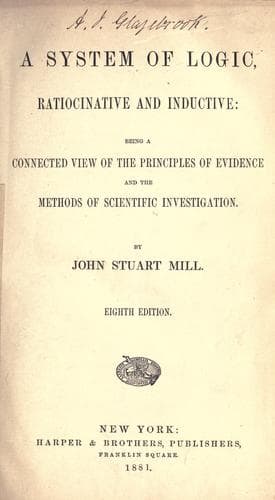
A System of Logic, Ratiocinative and InductiveMill, John Stuart
PhilosophyPhilosophy
A System of Logic, Ratiocinative and Inductive
Mill, John Stuart
Knowledge, Theory of; Logic; Science -- Methodology
refused to stand to it in the individual case. There is an inconsistency
to be avoided between the memorandum we make of the inferences which may
be justly drawn in future cases, and the inferences we actually draw in
those cases when they arise. With this view we interpret our own formula,
precisely as a judge interprets a law: in order that we may avoid drawing
any inferences not conformable to our former intention, as a judge avoids
giving any decision not conformable to the legislator’s intention. The
rules for this interpretation are the rules of the syllogism: and its sole
purpose is to maintain consistency between the conclusions we draw in
every particular case, and the previous general directions for drawing
them; whether those general directions were framed by ourselves as the
result of induction, or were received by us from an authority competent to
give them.
§ 5. In the above observations it has, I think, been shown, that, though
there is always a process of reasoning or inference where a syllogism is
used, the syllogism is not a correct analysis of that process of reasoning
or inference; which is, on the contrary (when not a mere inference from
testimony), an inference from particulars to particulars; authorized by a
previous inference from particulars to generals, and substantially the
same with it; of the nature, therefore, of Induction. But while these
conclusions appear to me undeniable, I must yet enter a protest, as strong
as that of Archbishop Whately himself, against the doctrine that the
syllogistic art is useless for the purposes of reasoning. The reasoning
lies in the act of generalization, not in interpreting the record of that
act; but the syllogistic form is an indispensable collateral security for
the correctness of the generalization itself.
It has already been seen, that if we have a collection of particulars
sufficient for grounding an induction, we need not frame a general
proposition; we may reason at once from those particulars to other
particulars. But it is to be remarked withal, that whenever, from a set of
particular cases, we can legitimately draw any inference, we may
legitimately make our inference a general one. If, from observation and
experiment, we can conclude to one new case, so may we to an indefinite
number. If that which has held true in our past experience will therefore
hold in time to come, it will hold not merely in some individual case, but
in all cases of some given description. Every induction, therefore, which
suffices to prove one fact, proves an indefinite multitude of facts: the
experience which justifies a single prediction must be such as will
suffice to bear out a general theorem. This theorem it is extremely
important to ascertain and declare, in its broadest form of generality;
and thus to place before our minds, in its full extent, the whole of what
our evidence must prove if it proves any thing.
Public-domain text, read in full here on John Shaqi.
Reviews
Reviews
No reviews yet
Be the first to share your thoughts on this work.
Elsewhere in the archive
Join the Discussion
Join the discussion
Sign in to leave a comment or review.
Sign InorCreate an account