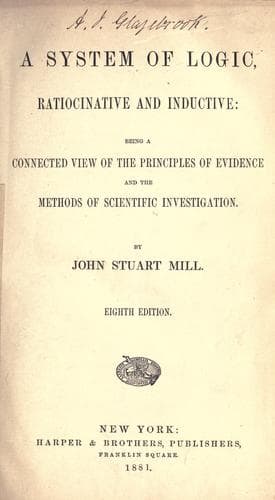
A System of Logic, Ratiocinative and InductiveMill, John Stuart
PhilosophyPhilosophy
A System of Logic, Ratiocinative and Inductive
Mill, John Stuart
Knowledge, Theory of; Logic; Science -- Methodology
This throwing of the whole body of possible inferences from a given set of
particulars, into one general expression, operates as a security for their
being just inferences, in more ways than one. First, the general principle
presents a larger object to the imagination than any of the singular
propositions which it contains. A process of thought which leads to a
comprehensive generality, is felt as of greater importance than one which
terminates in an insulated fact; and the mind is, even unconsciously, led
to bestow greater attention upon the process, and to weigh more carefully
the sufficiency of the experience appealed to, for supporting the
inference grounded upon it. There is another, and a more important,
advantage. In reasoning from a course of individual observations to some
new and unobserved case, which we are but imperfectly acquainted with (or
we should not be inquiring into it), and in which, since we are inquiring
into it, we probably feel a peculiar interest; there is very little to
prevent us from giving way to negligence, or to any bias which may affect
our wishes or our imagination, and, under that influence, accepting
insufficient evidence as sufficient. But if, instead of concluding
straight to the particular case, we place before ourselves an entire class
of facts—the whole contents of a general proposition, every tittle of
which is legitimately inferable from our premises, if that one particular
conclusion is so; there is then a considerable likelihood that if the
premises are insufficient, and the general inference therefore,
groundless, it will comprise within it some fact or facts the reverse of
which we already know to be true; and we shall thus discover the error in
our generalization by a _reductio ad impossibile_.
Thus if, during the reign of Marcus Aurelius, a subject of the Roman
empire, under the bias naturally given to the imagination and expectations
by the lives and characters of the Antonines, had been disposed to expect
that Commodus would be a just ruler; supposing him to stop there, he might
only have been undeceived by sad experience. But if he reflected that this
expectation could not be justifiable unless from the same evidence he was
warranted in concluding some general proposition, as, for instance, that
all Roman emperors are just rulers; he would immediately have thought of
Nero, Domitian, and other instances, which, showing the falsity of the
general conclusion, and therefore the insufficiency of the premises, would
have warned him that those premises could not prove in the instance of
Commodus, what they were inadequate to prove in any collection of cases in
which his was included.
Public-domain text, read in full here on John Shaqi.
Reviews
Reviews
No reviews yet
Be the first to share your thoughts on this work.
Elsewhere in the archive
Join the Discussion
Join the discussion
Sign in to leave a comment or review.
Sign InorCreate an account