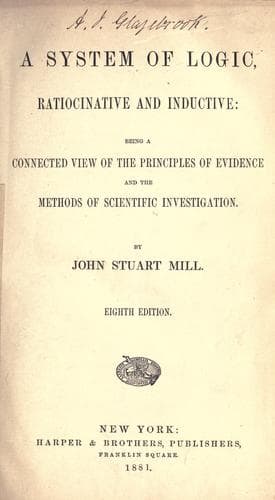
A System of Logic, Ratiocinative and InductiveMill, John Stuart
PhilosophyPhilosophy
A System of Logic, Ratiocinative and Inductive
Mill, John Stuart
Knowledge, Theory of; Logic; Science -- Methodology
§ 6. To complete the series of considerations connected with the
philosophical character of the syllogism, it is requisite to consider,
since the syllogism is not the universal type of the reasoning process,
what is the real type. This resolves itself into the question, what is the
nature of the minor premise, and in what manner it contributes to
establish the conclusion: for as to the major, we now fully understand,
that the place which it nominally occupies in our reasonings, properly
belongs to the individual facts or observations of which it expresses the
general result; the major itself being no real part of the argument, but
an intermediate halting-place for the mind, interposed by an artifice of
language between the real premises and the conclusion, by way of a
security, which it is in a most material degree, for the correctness of
the process. The minor, however, being an indispensable part of the
syllogistic expression of an argument, without doubt either is, or
corresponds to, an equally indispensable part of the argument itself, and
we have only to inquire what part.
It is perhaps worth while to notice here a speculation of a philosopher to
whom mental science is much indebted, but who, though a very penetrating,
was a very hasty thinker, and whose want of due circumspection rendered
him fully as remarkable for what he did not see, as for what he saw. I
allude to Dr. Thomas Brown, whose theory of ratiocination is peculiar. He
saw the _petitio principii_ which is inherent in every syllogism, if we
consider the major to be itself the evidence by which the conclusion is
proved, instead of being, what in fact it is, an assertion of the
existence of evidence sufficient to prove any conclusion of a given
description. Seeing this, Dr. Brown not only failed to see the immense
advantage, in point of security for correctness, which is gained by
interposing this step between the real evidence and the conclusion; but he
thought it incumbent on him to strike out the major altogether from the
reasoning process, without substituting any thing else, and maintained
that our reasonings consist only of the minor premise and the conclusion,
Socrates is a man, therefore Socrates is mortal: thus actually
suppressing, as an unnecessary step in the argument, the appeal to former
experience. The absurdity of this was disguised from him by the opinion he
adopted, that reasoning is merely analyzing our own general notions, or
abstract ideas; and that the proposition, Socrates is mortal, is evolved
from the proposition, Socrates is a man, simply by recognizing the notion
of mortality as already contained in the notion we form of a man.
Public-domain text, read in full here on John Shaqi.
Reviews
Reviews
No reviews yet
Be the first to share your thoughts on this work.
Elsewhere in the archive
Join the Discussion
Join the discussion
Sign in to leave a comment or review.
Sign InorCreate an account