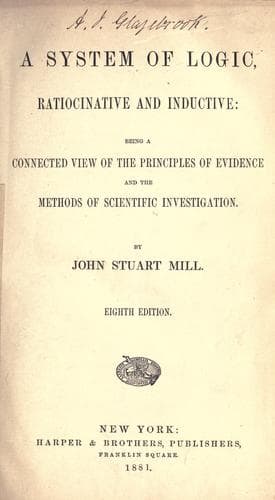
A System of Logic, Ratiocinative and InductiveMill, John Stuart
PhilosophyPhilosophy
A System of Logic, Ratiocinative and Inductive
Mill, John Stuart
Knowledge, Theory of; Logic; Science -- Methodology
After the explanations so fully entered into on the subject of
propositions, much further discussion can not be necessary to make the
radical error of this view of ratiocination apparent. If the word man
connoted mortality; if the meaning of “mortal” were involved in the
meaning of “man;” we might, undoubtedly, evolve the conclusion from the
minor alone, because the minor would have already asserted it. But if, as
is in fact the case, the word man does not connote mortality, how does it
appear that in the mind of every person who admits Socrates to be a man,
the idea of man must include the idea of mortality? Dr. Brown could not
help seeing this difficulty, and in order to avoid it, was led, contrary
to his intention, to re-establish, under another name, that step in the
argument which corresponds to the major, by affirming the necessity of
_previously perceiving_ the relation between the idea of man and the idea
of mortal. If the reasoner has not previously perceived this relation, he
will not, says Dr. Brown, infer because Socrates is a man, that Socrates
is mortal. But even this admission, though amounting to a surrender of the
doctrine that an argument consists of the minor and the conclusion alone,
will not save the remainder of Dr. Brown’s theory. The failure of assent
to the argument does not take place merely because the reasoner, for want
of due analysis, does not perceive that his idea of man includes the idea
of mortality; it takes place, much more commonly, because in his mind that
relation between the two ideas has never existed. And in truth it never
does exist, except as the result of experience. Consenting, for the sake
of the argument, to discuss the question on a supposition of which we have
recognized the radical incorrectness, namely, that the meaning of a
proposition relates to the ideas of the things spoken of, and not to the
things themselves; I must yet observe, that the idea of man, as a
universal idea, the common property of all rational creatures, can not
involve any thing but what is strictly implied in the name. If any one
includes in his own private idea of man, as no doubt is always the case,
some other attributes, such for instance as mortality, he does so only as
the consequence of experience, after having satisfied himself that all men
possess that attribute: so that whatever the idea contains, in any
person’s mind, beyond what is included in the conventional signification
of the word, has been added to it as the result of assent to a
proposition; while Dr. Brown’s theory requires us to suppose, on the
contrary, that assent to the proposition is produced by evolving, through
an analytic process, this very element out of the idea. This theory,
therefore, may be considered as sufficiently refuted; and the minor
premise must be regarded as totally insufficient to prove the conclusion,
except with the assistance of the major, or of that which the major
Public-domain text, read in full here on John Shaqi.
Reviews
Reviews
No reviews yet
Be the first to share your thoughts on this work.
Elsewhere in the archive
Join the Discussion
Join the discussion
Sign in to leave a comment or review.
Sign InorCreate an account