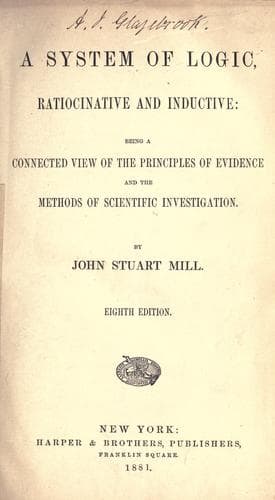
A System of Logic, Ratiocinative and InductiveMill, John Stuart
PhilosophyPhilosophy
A System of Logic, Ratiocinative and Inductive
Mill, John Stuart
Knowledge, Theory of; Logic; Science -- Methodology
In these various transformations, the propositions of the science of
number do but fulfill the function proper to all propositions forming a
train of reasoning, viz., that of enabling us to arrive in an indirect
method, by marks of marks, at such of the properties of objects as we can
not directly ascertain (or not so conveniently) by experiment. We travel
from a given visible or tangible fact, through the truths of numbers, to
the facts sought. The given fact is a mark that a certain relation
subsists between the quantities of some of the elements concerned; while
the fact sought presupposes a certain relation between the quantities of
some other elements: now, if these last quantities are dependent in some
known manner upon the former, or _vicè versa_, we can argue from the
numerical relation between the one set of quantities, to determine that
which subsists between the other set; the theorems of the calculus
affording the intermediate links. And thus one of the two physical facts
becomes a mark of the other, by being a mark of a mark of a mark of it.
Chapter V.
Of Demonstration, And Necessary Truths.
§ 1. If, as laid down in the two preceding chapters, the foundation of all
sciences, even deductive or demonstrative sciences, is Induction; if every
step in the ratiocinations even of geometry is an act of induction; and if
a train of reasoning is but bringing many inductions to bear upon the same
subject of inquiry, and drawing a case within one induction by means of
another; wherein lies the peculiar certainty always ascribed to the
sciences which are entirely, or almost entirely, deductive? Why are they
called the Exact Sciences? Why are mathematical certainty, and the
evidence of demonstration, common phrases to express the very highest
degree of assurance attainable by reason? Why are mathematics by almost
all philosophers, and (by some) even those branches of natural philosophy
which, through the medium of mathematics, have been converted into
deductive sciences, considered to be independent of the evidence of
experience and observation, and characterized as systems of Necessary
Truth?
Public-domain text, read in full here on John Shaqi.
Reviews
Reviews
No reviews yet
Be the first to share your thoughts on this work.
Elsewhere in the archive
Join the Discussion
Join the discussion
Sign in to leave a comment or review.
Sign InorCreate an account