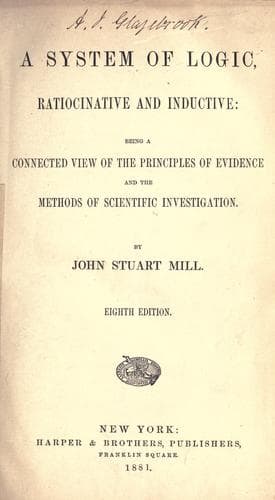
A System of Logic, Ratiocinative and InductiveMill, John Stuart
PhilosophyPhilosophy
A System of Logic, Ratiocinative and Inductive
Mill, John Stuart
Knowledge, Theory of; Logic; Science -- Methodology
The answer I conceive to be, that this character of necessity, ascribed to
the truths of mathematics, and (even with some reservations to be
hereafter made) the peculiar certainty attributed to them, is an illusion;
in order to sustain which, it is necessary to suppose that those truths
relate to, and express the properties of, purely imaginary objects. It is
acknowledged that the conclusions of geometry are deduced, partly at
least, from the so-called Definitions, and that those definitions are
assumed to be correct representations, as far as they go, of the objects
with which geometry is conversant. Now we have pointed out that, from a
definition as such, no proposition, unless it be one concerning the
meaning of a word, can ever follow; and that what apparently follows from
a definition, follows in reality from an implied assumption that there
exists a real thing conformable thereto. This assumption, in the case of
the definitions of geometry, is not strictly true: there exist no real
things exactly conformable to the definitions. There exist no points
without magnitude; no lines without breadth, nor perfectly straight; no
circles with all their radii exactly equal, nor squares with all their
angles perfectly right. It will perhaps be said that the assumption does
not extend to the actual, but only to the possible, existence of such
things. I answer that, according to any test we have of possibility, they
are not even possible. Their existence, so far as we can form any
judgment, would seem to be inconsistent with the physical constitution of
our planet at least, if not of the universe. To get rid of this
difficulty, and at the same time to save the credit of the supposed system
of necessary truth, it is customary to say that the points, lines,
circles, and squares which are the subject of geometry, exist in our
conceptions merely, and are part of our minds; which minds, by working on
their own materials, construct an _a priori_ science, the evidence of
which is purely mental, and has nothing whatever to do with outward
experience. By howsoever high authorities this doctrine may have been
sanctioned, it appears to me psychologically incorrect. The points, lines,
circles, and squares which any one has in his mind, are (I apprehend)
simply copies of the points, lines, circles, and squares which he has
known in his experience. Our idea of a point, I apprehend to be simply our
idea of the _minimum visibile_, the smallest portion of surface which we
can see. A line, as defined by geometers, is wholly inconceivable. We can
reason about a line as if it had no breadth; because we have a power,
which is the foundation of all the control we can exercise over the
operations of our minds; the power, when a perception is present to our
senses, or a conception to our intellects, of _attending_ to a part only
of that perception or conception, instead of the whole. But we can not
_conceive_ a line without breadth; we can form no mental picture of such a
Public-domain text, read in full here on John Shaqi.
Reviews
Reviews
No reviews yet
Be the first to share your thoughts on this work.
Elsewhere in the archive
Join the Discussion
Join the discussion
Sign in to leave a comment or review.
Sign InorCreate an account