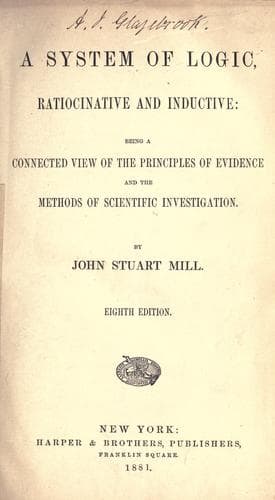
A System of Logic, Ratiocinative and InductiveMill, John Stuart
PhilosophyPhilosophy
A System of Logic, Ratiocinative and Inductive
Mill, John Stuart
Knowledge, Theory of; Logic; Science -- Methodology
These considerations also remove the objection arising from the
impossibility of ocularly following the lines in their prolongation to
infinity. For though, in order actually to see that two given lines never
meet, it would be necessary to follow them to infinity; yet without doing
so we may know that if they ever do meet, or if, after diverging from one
another, they begin again to approach, this must take place not at an
infinite, but at a finite distance. Supposing, therefore, such to be the
case, we can transport ourselves thither in imagination, and can frame a
mental image of the appearance which one or both of the lines must present
at that point, which we may rely on as being precisely similar to the
reality. Now, whether we fix our contemplation upon this imaginary
picture, or call to mind the generalizations we have had occasion to make
from former ocular observation, we learn by the evidence of experience,
that a line which, after diverging from another straight line, begins to
approach to it, produces the impression on our senses which we describe by
the expression, “a bent line,” not by the expression, “a straight
line.”(73)
The preceding argument, which is, to my mind unanswerable, merges,
however, in a still more comprehensive one, which is stated most clearly
and conclusively by Professor Bain. The psychological reason why axioms,
and indeed many propositions not ordinarily classed as such, may be
learned from the idea only without referring to the fact, is that in the
process of acquiring the idea we have learned the fact. The proposition is
assented to as soon as the terms are understood, because in learning to
understand the terms we have acquired the experience which proves the
proposition to be true. “We required,” says Mr. Bain,(74) “concrete
experience in the first instance, to attain to the notion of whole and
part; but the notion, once arrived at, implies that the whole is greater.
In fact, we could not have the notion without an experience tantamount to
this conclusion.... When we have mastered the notion of straightness, we
have also mastered that aspect of it expressed by the affirmation that two
straight lines can not inclose a space. No intuitive or innate powers or
perceptions are needed in such case.... We can not have the full meaning
of Straightness, without going through a comparison of straight objects
among themselves, and with their opposites, bent or crooked objects. The
result of this comparison is, _inter alia_, that straightness in two lines
is seen to be incompatible with inclosing a space; the inclosure of space
involves crookedness in at least one of the lines.” And similarly, in the
case of every first principle,(75) “the same knowledge that makes it
understood, suffices to verify it.” The more this observation is
considered the more (I am convinced) it will be felt to go to the very
root of the controversy.
Public-domain text, read in full here on John Shaqi.
Reviews
Reviews
No reviews yet
Be the first to share your thoughts on this work.
Elsewhere in the archive
Join the Discussion
Join the discussion
Sign in to leave a comment or review.
Sign InorCreate an account