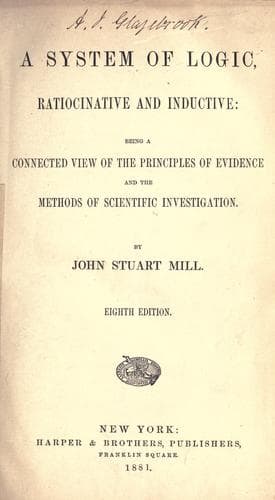
A System of Logic, Ratiocinative and InductiveMill, John Stuart
PhilosophyPhilosophy
A System of Logic, Ratiocinative and Inductive
Mill, John Stuart
Knowledge, Theory of; Logic; Science -- Methodology
§ 6. The first of the two arguments in support of the theory that axioms
are _a priori_ truths, having, I think, been sufficiently answered; I
proceed to the second, which is usually the most relied on. Axioms (it is
asserted) are conceived by us not only as true, but as universally and
necessarily true. Now, experience can not possibly give to any proposition
this character. I may have seen snow a hundred times, and may have seen
that it was white, but this can not give me entire assurance even that all
snow is white; much less that snow _must_ be white. “However many
instances we may have observed of the truth of a proposition, there is
nothing to assure us that the next case shall not be an exception to the
rule. If it be strictly true that every ruminant animal yet known has
cloven hoofs, we still can not be sure that some creature will not
hereafter be discovered which has the first of these attributes, without
having the other.... Experience must always consist of a limited number of
observations; and, however numerous these may be, they can show nothing
with regard to the infinite number of cases in which the experiment has
not been made.” Besides, Axioms are not only universal, they are also
necessary. Now “experience can not offer the smallest ground for the
necessity of a proposition. She can observe and record what has happened;
but she can not find, in any case, or in any accumulation of cases, any
reason for what _must_ happen. She may see objects side by side; but she
can not see a reason why they must ever be side by side. She finds certain
events to occur in succession; but the succession supplies, in its
occurrence, no reason for its recurrence. She contemplates external
objects; but she can not detect any internal bond, which indissolubly
connects the future with the past, the possible with the real. To learn a
proposition by experience, and to see it to be necessarily true, are two
altogether different processes of thought.”(76) And Dr. Whewell adds, “If
any one does not clearly comprehend this distinction of necessary and
contingent truths, he will not be able to go along with us in our
researches into the foundations of human knowledge; nor, indeed, to pursue
with success any speculation on the subject.”(77)
In the following passage, we are told what the distinction is, the
non-recognition of which incurs this denunciation. “Necessary truths are
those in which we not only learn that the proposition _is_ true, but see
that it _must be_ true; in which the negation of the truth is not only
false, but impossible; in which we can not, even by an effort of
imagination, or in a supposition, conceive the reverse of that which is
asserted. That there are such truths can not be doubted. We may take, for
example, all relations of number. Three and Two added together make Five.
We can not conceive it to be otherwise. We can not, by any freak of
thought, imagine Three and Two to make Seven.”(78)
Public-domain text, read in full here on John Shaqi.
Reviews
Reviews
No reviews yet
Be the first to share your thoughts on this work.
Elsewhere in the archive
Join the Discussion
Join the discussion
Sign in to leave a comment or review.
Sign InorCreate an account