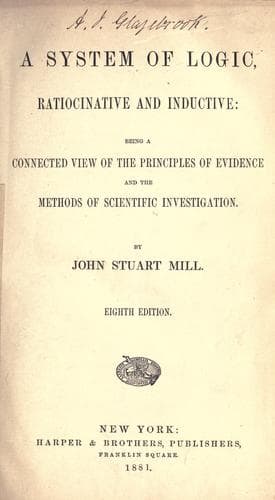
A System of Logic, Ratiocinative and InductiveMill, John Stuart
PhilosophyPhilosophy
A System of Logic, Ratiocinative and Inductive
Mill, John Stuart
Knowledge, Theory of; Logic; Science -- Methodology
Although Dr. Whewell has naturally and properly employed a variety of
phrases to bring his meaning more forcibly home, he would, I presume,
allow that they are all equivalent; and that what he means by a necessary
truth, would be sufficiently defined, a proposition the negation of which
is not only false but inconceivable. I am unable to find in any of his
expressions, turn them what way you will, a meaning beyond this, and I do
not believe he would contend that they mean any thing more.
This, therefore, is the principle asserted: that propositions, the
negation of which is inconceivable, or in other words, which we can not
figure to ourselves as being false, must rest on evidence of a higher and
more cogent description than any which experience can afford.
Now I can not but wonder that so much stress should be laid on the
circumstance of inconceivableness, when there is such ample experience to
show, that our capacity or incapacity of conceiving a thing has very
little to do with the possibility of the thing in itself; but is in truth
very much an affair of accident, and depends on the past history and
habits of our own minds. There is no more generally acknowledged fact in
human nature, than the extreme difficulty at first felt in conceiving any
thing as possible, which is in contradiction to long established and
familiar experience; or even to old familiar habits of thought. And this
difficulty is a necessary result of the fundamental laws of the human
mind. When we have often seen and thought of two things together, and have
never in any one instance either seen or thought of them separately, there
is by the primary law of association an increasing difficulty, which may
in the end become insuperable, of conceiving the two things apart. This is
most of all conspicuous in uneducated persons, who are in general utterly
unable to separate any two ideas which have once become firmly associated
in their minds; and if persons of cultivated intellect have any advantage
on the point, it is only because, having seen and heard and read more, and
being more accustomed to exercise their imagination, they have experienced
their sensations and thoughts in more varied combinations, and have been
prevented from forming many of these inseparable associations. But this
advantage has necessarily its limits. The most practiced intellect is not
exempt from the universal laws of our conceptive faculty. If daily habit
presents to any one for a long period two facts in combination, and if he
is not led during that period either by accident or by his voluntary
mental operations to think of them apart, he will probably in time become
incapable of doing so even by the strongest effort; and the supposition
that the two facts can be separated in nature, will at last present itself
to his mind with all the characters of an inconceivable phenomenon.(79)
There are remarkable instances of this in the history of science:
Public-domain text, read in full here on John Shaqi.
Reviews
Reviews
No reviews yet
Be the first to share your thoughts on this work.
Elsewhere in the archive
Join the Discussion
Join the discussion
Sign in to leave a comment or review.
Sign InorCreate an account