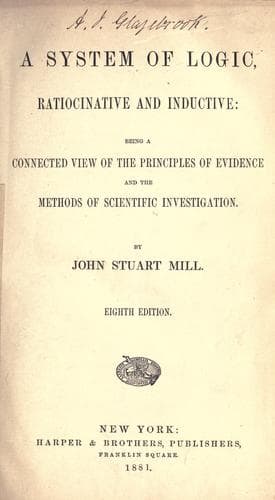
A System of Logic, Ratiocinative and InductiveMill, John Stuart
PhilosophyPhilosophy
A System of Logic, Ratiocinative and Inductive
Mill, John Stuart
Knowledge, Theory of; Logic; Science -- Methodology
If, then, it be so natural to the human mind, even in a high state of
culture, to be incapable of conceiving, and on that ground to believe
impossible, what is afterward not only found to be conceivable but proved
to be true; what wonder if in cases where the association is still older,
more confirmed, and more familiar, and in which nothing ever occurs to
shake our conviction, or even suggest to us any conception at variance
with the association, the acquired incapacity should continue, and be
mistaken for a natural incapacity? It is true, our experience of the
varieties in nature enables us, within certain limits, to conceive other
varieties analogous to them. We can conceive the sun or moon falling; for
though we never saw them fall, nor ever, perhaps, imagined them falling,
we have seen so many other things fall, that we have innumerable familiar
analogies to assist the conception; which, after all, we should probably
have some difficulty in framing, were we not well accustomed to see the
sun and moon move (or appear to move), so that we are only called upon to
conceive a slight change in the direction of motion, a circumstance
familiar to our experience. But when experience affords no model on which
to shape the new conception, how is it possible for us to form it? How,
for example, can we imagine an end to space or time? We never saw any
object without something beyond it, nor experienced any feeling without
something following it. When, therefore, we attempt to conceive the last
point of space, we have the idea irresistibly raised of other points
beyond it. When we try to imagine the last instant of time, we can not
help conceiving another instant after it. Nor is there any necessity to
assume, as is done by a modern school of metaphysicians, a peculiar
fundamental law of the mind to account for the feeling of infinity
inherent in our conceptions of space and time; that apparent infinity is
sufficiently accounted for by simpler and universally acknowledged laws.
Public-domain text, read in full here on John Shaqi.
Reviews
Reviews
No reviews yet
Be the first to share your thoughts on this work.
Elsewhere in the archive
Join the Discussion
Join the discussion
Sign in to leave a comment or review.
Sign InorCreate an account