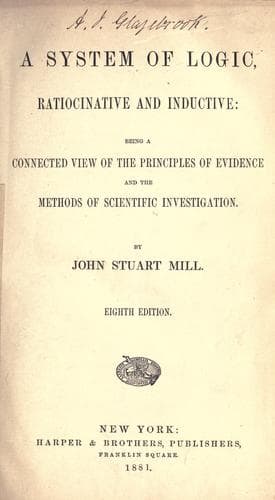
A System of Logic, Ratiocinative and InductiveMill, John Stuart
PhilosophyPhilosophy
A System of Logic, Ratiocinative and Inductive
Mill, John Stuart
Knowledge, Theory of; Logic; Science -- Methodology
Now, in the case of a geometrical axiom, such, for example, as that two
straight lines can not inclose a space—a truth which is testified to us by
our very earliest impressions of the external world—how is it possible
(whether those external impressions be or be not the ground of our belief)
that the reverse of the proposition _could_ be otherwise than
inconceivable to us? What analogy have we, what similar order of facts in
any other branch of our experience, to facilitate to us the conception of
two straight lines inclosing a space? Nor is even this all. I have already
called attention to the peculiar property of our impressions of form, that
the ideas or mental images exactly resemble their prototypes, and
adequately represent them for the purposes of scientific observation. From
this, and from the intuitive character of the observation, which in this
case reduces itself to simple inspection, we can not so much as call up in
our imagination two straight lines, in order to attempt to conceive them
inclosing a space, without by that very act repeating the scientific
experiment which establishes the contrary. Will it really be contended
that the inconceivableness of the thing, in such circumstances, proves any
thing against the experimental origin of the conviction? Is it not clear
that in whichever mode our belief in the proposition may have originated,
the impossibility of our conceiving the negative of it must, on either
hypothesis, be the same? As, then, Dr. Whewell exhorts those who have any
difficulty in recognizing the distinction held by him between necessary
and contingent truths, to study geometry—a condition which I can assure
him I have conscientiously fulfilled—I, in return, with equal confidence,
exhort those who agree with him, to study the general laws of association;
being convinced that nothing more is requisite than a moderate familiarity
with those laws, to dispel the illusion which ascribes a peculiar
necessity to our earliest inductions from experience, and measures the
possibility of things in themselves, by the human capacity of conceiving
them.
Public-domain text, read in full here on John Shaqi.
Reviews
Reviews
No reviews yet
Be the first to share your thoughts on this work.
Elsewhere in the archive
Join the Discussion
Join the discussion
Sign in to leave a comment or review.
Sign InorCreate an account