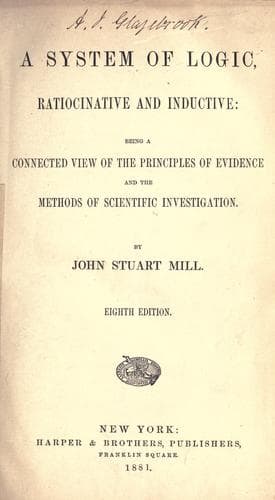
A System of Logic, Ratiocinative and InductiveMill, John Stuart
PhilosophyPhilosophy
A System of Logic, Ratiocinative and Inductive
Mill, John Stuart
Knowledge, Theory of; Logic; Science -- Methodology
This last proposition is precisely what I contend for; and I ask no more,
in order to overthrow the whole theory of its author on the nature of the
evidence of axioms. For what is that theory? That the truth of axioms can
not have been learned from experience, because their falsity is
inconceivable. But Dr. Whewell himself says, that we are continually led,
by the natural progress of thought, to regard as inconceivable what our
forefathers not only conceived but believed, nay even (he might have
added) were unable to conceive the reverse of. He can not intend to
justify this mode of thought: he can not mean to say, that we can be right
in regarding as inconceivable what others have conceived, and as
self-evident what to others did not appear evident at all. After so
complete an admission that inconceivableness is an accidental thing, not
inherent in the phenomenon itself, but dependent on the mental history of
the person who tries to conceive it, how can he ever call upon us to
reject a proposition as impossible on no other ground than its
inconceivableness? Yet he not only does so, but has unintentionally
afforded some of the most remarkable examples which can be cited of the
very illusion which he has himself so clearly pointed out. I select as
specimens, his remarks on the evidence of the three laws of motion, and of
the atomic theory.
With respect to the laws of motion, Dr. Whewell says: “No one can doubt
that, in historical fact, these laws were collected from experience. That
such is the case, is no matter of conjecture. We know the time, the
persons, the circumstances, belonging to each step of each discovery.”(82)
After this testimony, to adduce evidence of the fact would be superfluous.
And not only were these laws by no means intuitively evident, but some of
them were originally paradoxes. The first law was especially so. That a
body, once in motion, would continue forever to move in the same direction
with undiminished velocity unless acted upon by some new force, was a
proposition which mankind found for a long time the greatest difficulty in
crediting. It stood opposed to apparent experience of the most familiar
kind, which taught that it was the nature of motion to abate gradually,
and at last terminate of itself. Yet when once the contrary doctrine was
firmly established, mathematicians, as Dr. Whewell observes, speedily
began to believe that laws, thus contradictory to first appearances, and
which, even after full proof had been obtained, it had required
generations to render familiar to the minds of the scientific world, were
under “a demonstrable necessity, compelling them to be such as they are
and no other;” and he himself, though not venturing “absolutely to
pronounce” that _all_ these laws “can be rigorously traced to an absolute
necessity in the nature of things,”(83) does actually so think of the law
just mentioned; of which he says: “Though the discovery of the first law
Public-domain text, read in full here on John Shaqi.
Reviews
Reviews
No reviews yet
Be the first to share your thoughts on this work.
Elsewhere in the archive
Join the Discussion
Join the discussion
Sign in to leave a comment or review.
Sign InorCreate an account