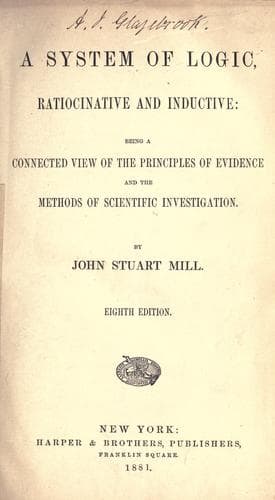
A System of Logic, Ratiocinative and InductiveMill, John Stuart
PhilosophyPhilosophy
A System of Logic, Ratiocinative and Inductive
Mill, John Stuart
Knowledge, Theory of; Logic; Science -- Methodology
I hope to be pardoned for adding, that Dr. Whewell himself has both
confirmed by his testimony the effect of habitual association in giving to
an experimental truth the appearance of a necessary one, and afforded a
striking instance of that remarkable law in his own person. In his
_Philosophy of the Inductive Sciences_ he continually asserts, that
propositions which not only are not self-evident, but which we know to
have been discovered gradually, and by great efforts of genius and
patience, have, when once established, appeared so self-evident that, but
for historical proof, it would have been impossible to conceive that they
had not been recognized from the first by all persons in a sound state of
their faculties. “We now despise those who, in the Copernican controversy,
could not conceive the apparent motion of the sun on the heliocentric
hypothesis; or those who, in opposition to Galileo, thought that a uniform
force might be that which generated a velocity proportional to the space;
or those who held there was something absurd in Newton’s doctrine of the
different refrangibility of differently colored rays; or those who
imagined that when elements combine, their sensible qualities must be
manifest in the compound; or those who were reluctant to give up the
distinction of vegetables into herbs, shrubs, and trees. We can not help
thinking that men must have been singularly dull of comprehension, to find
a difficulty in admitting what is to us so plain and simple. We have a
latent persuasion that we in their place should have been wiser and more
clear-sighted; that we should have taken the right side, and given our
assent at once to the truth. Yet in reality such a persuasion is a mere
delusion. The persons who, in such instances as the above, were on the
losing side, were very far, in most cases, from being persons more
prejudiced, or stupid, or narrow-minded, than the greater part of mankind
now are; and the cause for which they fought was far from being a
manifestly bad one, till it had been so decided by the result of the
war.... So complete has been the victory of truth in most of these
instances, that at present we can hardly imagine the struggle to have been
necessary. _The very essence of these triumphs is, that they lead us to
regard the views we reject as not only false but inconceivable._”(81)
Public-domain text, read in full here on John Shaqi.
Reviews
Reviews
No reviews yet
Be the first to share your thoughts on this work.
Elsewhere in the archive
Join the Discussion
Join the discussion
Sign in to leave a comment or review.
Sign InorCreate an account