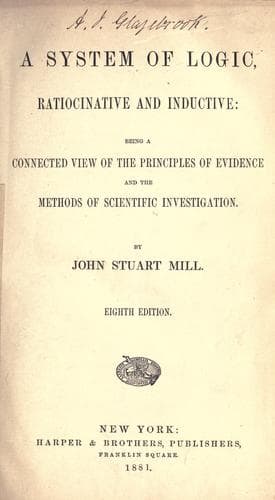
A System of Logic, Ratiocinative and InductiveMill, John Stuart
PhilosophyPhilosophy
A System of Logic, Ratiocinative and Inductive
Mill, John Stuart
Knowledge, Theory of; Logic; Science -- Methodology
§ 4. It appears, therefore, that the method of all Deductive Sciences is
hypothetical. They proceed by tracing the consequences of certain
assumptions; leaving for separate consideration whether the assumptions
are true or not, and if not exactly true, whether they are a sufficiently
near approximation to the truth. The reason is obvious. Since it is only
in questions of pure number that the assumptions are exactly true, and
even there only so long as no conclusions except purely numerical ones are
to be founded on them; it must, in all other cases of deductive
investigation, form a part of the inquiry, to determine how much the
assumptions want of being exactly true in the case in hand. This is
generally a matter of observation, to be repeated in every fresh case; or
if it has to be settled by argument instead of observation, may require in
every different case different evidence, and present every degree of
difficulty, from the lowest to the highest. But the other part of the
process—namely, to determine what else may be concluded if we find, and in
proportion as we find, the assumptions to be true—may be performed once
for all, and the results held ready to be employed as the occasions turn
up for use. We thus do all beforehand that can be so done, and leave the
least possible work to be performed when cases arise and press for a
decision. This inquiry into the inferences which can be drawn from
assumptions, is what properly constitutes Demonstrative Science.
It is of course quite as practicable to arrive at new conclusions from
facts assumed, as from facts observed; from fictitious, as from real,
inductions. Deduction, as we have seen, consists of a series of inferences
in this form—_a_ is a mark of _b_, _b_ of _c_, _c_ of _d_, therefore _a_
is a mark of _d_, which last may be a truth inaccessible to direct
observation. In like manner it is allowable to say, _suppose_ that a were
a mark of _b_, _b_ of _c_, and _c_ of _d_, _a_ would be a mark of _d_,
which last conclusion was not thought of by those who laid down the
premises. A system of propositions as complicated as geometry might be
deduced from assumptions which are false; as was done by Ptolemy,
Descartes, and others, in their attempts to explain synthetically the
phenomena of the solar system on the supposition that the apparent motions
of the heavenly bodies were the real motions, or were produced in some way
more or less different from the true one. Sometimes the same thing is
knowingly done, for the purpose of showing the falsity of the assumption;
which is called a _reductio ad absurdum_. In such cases, the reasoning is
as follows: _a_ is a mark of _b_, and _b_ of _c_; now if c were also a
mark of _d, a_ would be a mark of _d_; but _d_ is known to be a mark of
the absence of _a_; consequently _a_ would be a mark of its own absence,
which is a contradiction; therefore _c_ is not a mark of _d_.
Public-domain text, read in full here on John Shaqi.
Reviews
Reviews
No reviews yet
Be the first to share your thoughts on this work.
Elsewhere in the archive
Join the Discussion
Join the discussion
Sign in to leave a comment or review.
Sign InorCreate an account