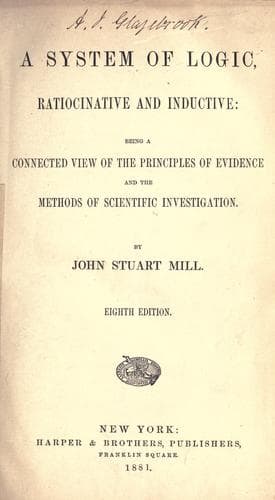
A System of Logic, Ratiocinative and InductiveMill, John Stuart
PhilosophyPhilosophy
A System of Logic, Ratiocinative and Inductive
Mill, John Stuart
Knowledge, Theory of; Logic; Science -- Methodology
§ 5. It has even been held by some writers, that all ratiocination rests
in the last resort on a _reductio ad absurdum_; since the way to enforce
assent to it, in case of obscurity, would be to show that if the
conclusion be denied we must deny some one at least of the premises,
which, as they are all supposed true, would be a contradiction. And in
accordance with this, many have thought that the peculiar nature of the
evidence of ratiocination consisted in the impossibility of admitting the
premises and rejecting the conclusion without a contradiction in terms.
This theory, however, is inadmissible as an explanation of the grounds on
which ratiocination itself rests. If any one denies the conclusion
notwithstanding his admission of the premises, he is not involved in any
direct and express contradiction until he is compelled to deny some
premise; and he can only be forced to do this by a _reductio ad absurdum_,
that is, by another ratiocination: now, if he denies the validity of the
reasoning process itself, he can no more be forced to assent to the second
syllogism than to the first. In truth, therefore, no one is ever forced to
a contradiction in terms: he can only be forced to a contradiction (or
rather an infringement) of the fundamental maxim of ratiocination, namely,
that whatever has a mark, has what it is a mark of; or (in the case of
universal propositions), that whatever is a mark of any thing, is a mark
of whatever else that thing is a mark of. For in the case of every correct
argument, as soon as thrown into the syllogistic form, it is evident
without the aid of any other syllogism, that he who, admitting the
premises, fails to draw the conclusion, does not conform to the above
axiom.
We have now proceeded as far in the theory of Deduction as we can advance
in the present stage of our inquiry. Any further insight into the subject
requires that the foundation shall have been laid of the philosophic
theory of Induction itself; in which theory that of Deduction, as a mode
of Induction, which we have now shown it to be, will assume spontaneously
the place which belongs to it, and will receive its share of whatever
light may be thrown upon the great intellectual operation of which it
forms so important a part.
Chapter VII.
Examination Of Some Opinions Opposed To The Preceding Doctrines.
§ 1. Polemical discussion is foreign to the plan of this work. But an
opinion which stands in need of much illustration, can often receive it
most effectually, and least tediously, in the form of a defense against
objections. And on subjects concerning which speculative minds are still
divided, a writer does but half his duty by stating his own doctrine, if
he does not also examine, and to the best of his ability judge, those of
other thinkers.
Public-domain text, read in full here on John Shaqi.
Reviews
Reviews
No reviews yet
Be the first to share your thoughts on this work.
Elsewhere in the archive
Join the Discussion
Join the discussion
Sign in to leave a comment or review.
Sign InorCreate an account