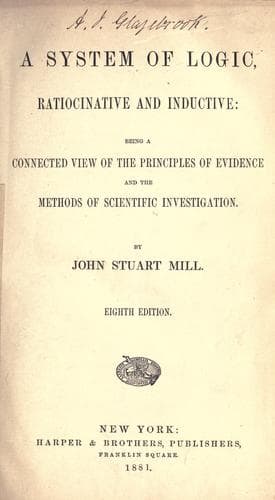
A System of Logic, Ratiocinative and InductiveMill, John Stuart
PhilosophyPhilosophy
A System of Logic, Ratiocinative and Inductive
Mill, John Stuart
Knowledge, Theory of; Logic; Science -- Methodology
Thus far, there is no very wide difference between Mr. Spencer’s doctrine
and the ordinary one of philosophers of the intuitive school, from
Descartes to Dr. Whewell; but at this point Mr. Spencer diverges from
them. For he does not, like them, set up the test of inconceivability as
infallible. On the contrary, he holds that it may be fallacious, not from
any fault in the test itself, but because “men have mistaken for
inconceivable things, some things which were not inconceivable.” And he
himself, in this very book, denies not a few propositions usually regarded
as among the most marked examples of truths whose negations are
inconceivable. But occasional failure, he says, is incident to all tests.
If such failure vitiates “the test of inconceivableness,” it “must
similarly vitiate all tests whatever. We consider an inference logically
drawn from established premises to be true. Yet in millions of cases men
have been wrong in the inferences they have thought thus drawn. Do we
therefore argue that it is absurd to consider an inference true on no
other ground than that it is logically drawn from established premises?
No: we say that though men may have taken for logical inferences,
inferences that were not logical, there nevertheless _are_ logical
inferences, and that we are justified in assuming the truth of what seem
to us such, until better instructed. Similarly, though men may have
thought some things inconceivable which were not so, there may still be
inconceivable things; and the inability to conceive the negation of a
thing, may still be our best warrant for believing it.... Though
occasionally it may prove an imperfect test, yet, as our most certain
beliefs are capable of no better, to doubt any one belief because we have
no higher guarantee for it, is really to doubt all beliefs.” Mr. Spencer’s
doctrine, therefore, does not erect the curable, but only the incurable
limitations of the human conceptive faculty, into laws of the outward
universe.
§ 2. The doctrine, that “a belief which is proved by the inconceivableness
of its negation to invariably exist, is true,” Mr. Spencer enforces by two
arguments, one of which may be distinguished as positive, and the other as
negative.
Public-domain text, read in full here on John Shaqi.
Reviews
Reviews
No reviews yet
Be the first to share your thoughts on this work.
Elsewhere in the archive
Join the Discussion
Join the discussion
Sign in to leave a comment or review.
Sign InorCreate an account