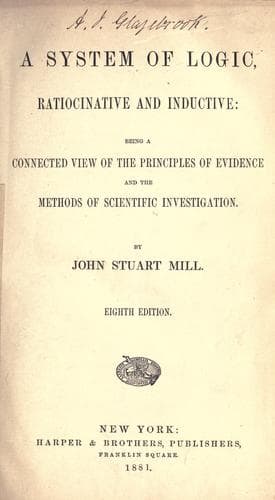
A System of Logic, Ratiocinative and InductiveMill, John Stuart
PhilosophyPhilosophy
A System of Logic, Ratiocinative and Inductive
Mill, John Stuart
Knowledge, Theory of; Logic; Science -- Methodology
In the dissertation which Mr. Herbert Spencer has prefixed to his, in many
respects, highly philosophical treatise on the Mind,(91) he criticises
some of the doctrines of the two preceding chapters, and propounds a
theory of his own on the subject of first principles. Mr. Spencer agrees
with me in considering axioms to be “simply our earliest inductions from
experience.” But he differs from me “widely as to the worth of the test of
inconceivableness.” He thinks that it is the ultimate test of all beliefs.
He arrives at this conclusion by two steps. First, we never can have any
stronger ground for believing any thing, than that the belief of it
“invariably exists.” Whenever any fact or proposition is invariably
believed; that is, if I understand Mr. Spencer rightly, believed by all
persons, and by one’s self at all times; it is entitled to be received as
one of the primitive truths, or original premises of our knowledge.
Secondly, the criterion by which we decide whether any thing is invariably
believed to be true, is our inability to conceive it as false. “The
inconceivability of its negation is the test by which we ascertain whether
a given belief invariably exists or not.” “For our primary beliefs, the
fact of invariable existence, tested by an abortive effort to cause their
non-existence, is the only reason assignable.” He thinks this the sole
ground of our belief in our own sensations. If I believe that I feel cold,
I only receive this as true because I can not conceive that I am not
feeling cold. “While the proposition remains true, the negation of it
remains inconceivable.” There are numerous other beliefs which Mr. Spencer
considers to rest on the same basis; being chiefly those, or a part of
those, which the metaphysicians of the Reid and Stewart school consider as
truths of immediate intuition. That there exists a material world; that
this is the very world which we directly and immediately perceive, and not
merely the hidden cause of our perceptions; that Space, Time, Force,
Extension, Figure, are not modes of our consciousness, but objective
realities; are regarded by Mr. Spencer as truths known by the
inconceivableness of their negatives. We can not, he says, by any effort,
conceive these objects of thought as mere states of our mind; as not
having an existence external to us. Their real existence is, therefore, as
certain as our sensations themselves. The truths which are the subject of
direct knowledge, being, according to this doctrine, known to be truths
only by the inconceivability of their negation; and the truths which are
not the object of direct knowledge, being known as inferences from those
which are; and those inferences being believed to follow from the
premises, only because we can not conceive them not to follow;
inconceivability is thus the ultimate ground of all assured beliefs.
Public-domain text, read in full here on John Shaqi.
Reviews
Reviews
No reviews yet
Be the first to share your thoughts on this work.
Elsewhere in the archive
Join the Discussion
Join the discussion
Sign in to leave a comment or review.
Sign InorCreate an account