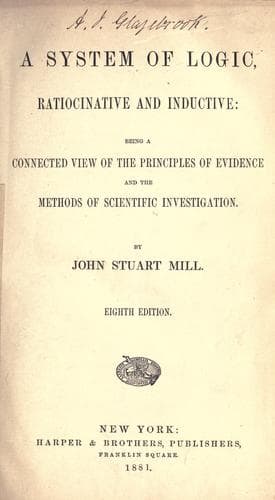
A System of Logic, Ratiocinative and InductiveMill, John Stuart
PhilosophyPhilosophy
A System of Logic, Ratiocinative and Inductive
Mill, John Stuart
Knowledge, Theory of; Logic; Science -- Methodology
I maintain then, first, that uniformity of past experience is very far
from being universally a criterion of truth. But secondly,
inconceivableness is still further from being a test even of that test.
Uniformity of contrary experience is only one of many causes of
inconceivability. Tradition handed down from a period of more limited
knowledge, is one of the commonest. The mere familiarity of one mode of
production of a phenomenon often suffices to make every other mode appear
inconceivable. Whatever connects two ideas by a strong association may,
and continually does, render their separation in thought impossible; as
Mr. Spencer, in other parts of his speculations, frequently recognizes. It
was not for want of experience that the Cartesians were unable to conceive
that one body could produce motion in another without contact. They had as
much experience of other modes of producing motion as they had of that
mode. The planets had revolved, and heavy bodies had fallen, every hour of
their lives. But they fancied these phenomena to be produced by a hidden
machinery which they did not see, because without it they were unable to
conceive what they did see. The inconceivableness, instead of representing
their experience, dominated and overrode their experience. Without
dwelling further on what I have termed the positive argument of Mr.
Spencer in support of his criterion of truth, I pass to his negative
argument, on which he lays more stress.
§ 3. The negative argument is, that, whether inconceivability be good
evidence or bad, no stronger evidence is to be obtained. That what is
inconceivable can not be true, is postulated in every act of thought. It
is the foundation of all our original premises. Still more it is assumed
in all conclusions from those premises. The invariability of belief,
tested by the inconceivableness of its negation, “is our sole warrant for
every demonstration. Logic is simply a systematization of the process by
which we indirectly obtain this warrant for beliefs that do not directly
possess it. To gain the strongest conviction possible respecting any
complex fact, we either analytically descend from it by successive steps,
each of which we unconsciously test by the inconceivableness of its
negation, until we reach some axiom or truth which we have similarly
tested; or we synthetically ascend from such axiom or truth by such steps.
In either case we connect some isolated belief, with a belief which
invariably exists, by a series of intermediate beliefs which invariably
exist.” The following passage sums up the theory: “When we perceive that
the negation of the belief is inconceivable, we have all possible warrant
for asserting the invariability of its existence: and in asserting this,
we express alike our logical justification of it, and the inexorable
necessity we are under of holding it.... We have seen that this is the
assumption on which every conclusion whatever ultimately rests. We have no
Public-domain text, read in full here on John Shaqi.
Reviews
Reviews
No reviews yet
Be the first to share your thoughts on this work.
Elsewhere in the archive
Join the Discussion
Join the discussion
Sign in to leave a comment or review.
Sign InorCreate an account