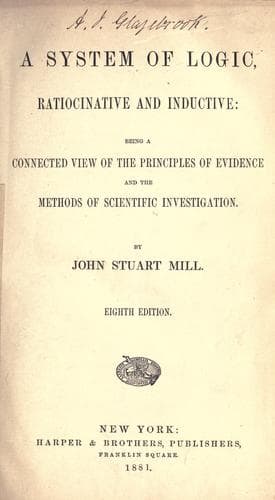
A System of Logic, Ratiocinative and InductiveMill, John Stuart
PhilosophyPhilosophy
A System of Logic, Ratiocinative and Inductive
Mill, John Stuart
Knowledge, Theory of; Logic; Science -- Methodology
other guarantee for the reality of consciousness, of sensations, of
personal existence; we have no other guarantee for any axiom; we have no
other guarantee for any step in a demonstration. Hence, as being taken for
granted in every act of the understanding, it must be regarded as the
Universal Postulate.” But as this postulate, which we are under an
“inexorable necessity” of holding true, is sometimes false; as “beliefs
that once were shown by the inconceivableness of their negations to
invariably exist, have since been found untrue,” and as “beliefs that now
possess this character may some day share the same fate;” the canon of
belief laid down by Mr. Spencer is, that “the most certain conclusion” is
that “which involves the postulate the fewest times.” Reasoning,
therefore, never ought to prevail against one of the immediate beliefs
(the belief in Matter, in the outward reality of Extension, Space, and the
like), because each of these involves the postulate only once; while an
argument, besides involving it in the premises, involves it again in every
step of the ratiocination, no one of the successive acts of inference
being recognized as valid except because we can not conceive the
conclusion not to follow from the premises.
It will be convenient to take the last part of this argument first. In
every reasoning, according to Mr. Spencer, the assumption of the postulate
is renewed at every step. At each inference we judge that the conclusion
follows from the premises, our sole warrant for that judgment being that
we can not conceive it not to follow. Consequently if the postulate is
fallible, the conclusions of reasoning are more vitiated by that
uncertainty than direct intuitions; and the disproportion is greater, the
more numerous the steps of the argument.
To test this doctrine, let us first suppose an argument consisting only of
a single step, which would be represented by one syllogism. This argument
does rest on an assumption, and we have seen in the preceding chapters
what the assumption is. It is, that whatever has a mark, has what it is a
mark of. The evidence of this axiom I shall not consider at present;(92)
let us suppose it (with Mr. Spencer) to be the inconceivableness of its
reverse.
Public-domain text, read in full here on John Shaqi.
Reviews
Reviews
No reviews yet
Be the first to share your thoughts on this work.
Elsewhere in the archive
Join the Discussion
Join the discussion
Sign in to leave a comment or review.
Sign InorCreate an account