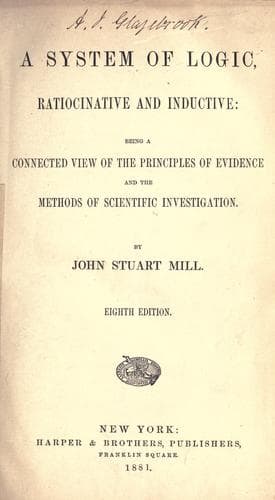
A System of Logic, Ratiocinative and InductiveMill, John Stuart
PhilosophyPhilosophy
A System of Logic, Ratiocinative and Inductive
Mill, John Stuart
Knowledge, Theory of; Logic; Science -- Methodology
It is but just to give Mr. Spencer’s doctrine the benefit of the
limitation he claims—viz., that it is only applicable to propositions
which are assented to on simple inspection, without any intervening media
of proof. But this limitation does not exclude some of the most marked
instances of propositions now known to be false or groundless, but whose
negative was once found inconceivable: such as, that in sunrise and sunset
it is the sun which moves; that gravitation may exist without an
intervening medium; and even the case of antipodes. The distinction drawn
by Mr. Spencer is real; but, in the case of the propositions classed by
him as complex, consciousness, until the media of proof are supplied,
gives no verdict at all: it neither declares the equality of the square of
the hypothenuse with the sum of the squares of the sides to be
inconceivable, nor their inequality to be inconceivable. But in all the
three cases which I have just cited, the inconceivability seems to be
apprehended directly; no train of argument was needed, as in the case of
the square of the hypothenuse, to obtain the verdict of consciousness on
the point. Neither is any of the three a case like that of the
school-boy’s mistake, in which the mind was never really brought into
contact with the proposition. They are cases in which one of two opposite
predicates, _mero adspectu_, seemed to be incompatible with the subject,
and the other, therefore, to be proved always to exist with it.(97)
As now limited by Mr. Spencer, the ultimate cognitions fit to be submitted
to his test are only those of so universal and elementary a character as
to be represented in the earliest and most unvarying experience, or
apparent experience, of all mankind. In such cases the inconceivability of
the negative, if real, is accounted for by the experience: and why (I have
asked) should the truth be tested by the inconceivability, when we can go
further back for proof—namely, to the experience itself? To this Mr.
Spencer answers, that the experiences can not be all recalled to mind, and
if recalled, would be of unmanageable multitude. To test a proposition by
experience seems to him to mean that “before accepting as certain the
proposition that any rectilineal figure must have as many angles as it has
sides,” I have “to think of every triangle, square, pentagon, hexagon,
etc., which I have ever seen, and to verify the asserted relation in each
case.” I can only say, with surprise, that I do not understand this to be
the meaning of an appeal to experience. It is enough to know that one has
been seeing the fact all one’s life, and has never remarked any instance
to the contrary, and that other people, with every opportunity of
observation, unanimously declare the same thing. It is true, even this
experience may be insufficient, and so it might be even if I could recall
to mind every instance of it; but its insufficiency, instead of being
Public-domain text, read in full here on John Shaqi.
Reviews
Reviews
No reviews yet
Be the first to share your thoughts on this work.
Elsewhere in the archive
Join the Discussion
Join the discussion
Sign in to leave a comment or review.
Sign InorCreate an account