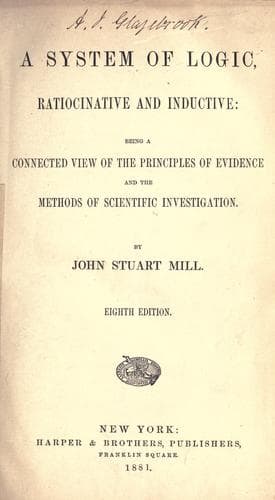
A System of Logic, Ratiocinative and InductiveMill, John Stuart
PhilosophyPhilosophy
A System of Logic, Ratiocinative and Inductive
Mill, John Stuart
Knowledge, Theory of; Logic; Science -- Methodology
“That some propositions have been wrongly accepted as true, because their
negations were supposed inconceivable when they were not,” does not, in
Mr. Spencer’s opinion, “disprove the validity of the test;” not only
because any test whatever “is liable to yield untrue results, either from
incapacity or from carelessness in those who use it,” but because the
propositions in question “were complex propositions, not to be established
by a test applicable to propositions no further decomposable.” “A test
legitimately applicable to a simple proposition, the subject and predicate
of which are in direct relation, can not be legitimately applied to a
complex proposition, the subject and predicate of which are indirectly
related through the many simple propositions implied.” “That things which
are equal to the same thing are equal to one another, is a fact which can
be known by direct comparison of actual or ideal relations.... But that
the square of the hypothenuse of a right-angled triangle equals the sum of
the squares of the other two sides, can not be known immediately by
comparison of two states of consciousness: here the truth can be reached
only mediately, through a series of simple judgments respecting the
likenesses or unlikenesses of certain relations.” Moreover, even when the
proposition admits of being tested by immediate consciousness, people
often neglect to do it. A school-boy, in adding up a column of figures,
will say “35 and 9 are 46,” though this is contrary to the verdict which
consciousness gives when 35 and 9 are really called up before it; but this
is not done. And not only school-boys, but men and thinkers, do not always
“distinctly translate into their equivalent states of consciousness the
words they use.”
Public-domain text, read in full here on John Shaqi.
Reviews
Reviews
No reviews yet
Be the first to share your thoughts on this work.
Elsewhere in the archive
Join the Discussion
Join the discussion
Sign in to leave a comment or review.
Sign InorCreate an account