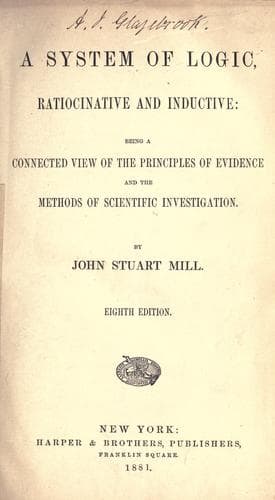
A System of Logic, Ratiocinative and InductiveMill, John Stuart
PhilosophyPhilosophy
A System of Logic, Ratiocinative and Inductive
Mill, John Stuart
Knowledge, Theory of; Logic; Science -- Methodology
But when he _has_ thought of something, science can tell him whether that
which he has thought of will suit his purpose or not. The inquirer or
arguer must be guided by his own knowledge and sagacity in the choice of
the inductions out of which he will construct his argument. But the
validity of the argument when constructed, depends on principles, and must
be tried by tests which are the same for all descriptions of inquiries,
whether the result be to give A an estate, or to enrich science with a new
general truth. In the one case and in the other, the senses, or testimony,
must decide on the individual facts; the rules of the syllogism will
determine whether, those facts being supposed correct, the case really
falls within the formulæ of the different inductions under which it has
been successively brought; and finally, the legitimacy of the inductions
themselves must be decided by other rules, and these it is now our purpose
to investigate. If this third part of the operation be, in many of the
questions of practical life, not the most, but the least arduous portion
of it, we have seen that this is also the case in some great departments
of the field of science; in all those which are principally deductive, and
most of all in mathematics; where the inductions themselves are few in
number, and so obvious and elementary that they seem to stand in no need
of the evidence of experience, while to combine them so as to prove a
given theorem or solve a problem, may call for the utmost powers of
invention and contrivance with which our species is gifted.
Public-domain text, read in full here on John Shaqi.
Reviews
Reviews
No reviews yet
Be the first to share your thoughts on this work.
Elsewhere in the archive
Join the Discussion
Join the discussion
Sign in to leave a comment or review.
Sign InorCreate an account