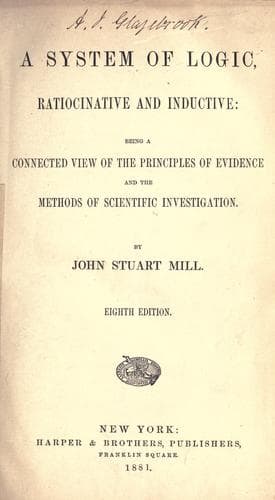
A System of Logic, Ratiocinative and InductiveMill, John Stuart
PhilosophyPhilosophy
A System of Logic, Ratiocinative and Inductive
Mill, John Stuart
Knowledge, Theory of; Logic; Science -- Methodology
If the identity of the logical processes which prove particular facts and
those which establish general scientific truths, required any additional
confirmation, it would be sufficient to consider that in many branches of
science, single facts have to be proved, as well as principles; facts as
completely individual as any that are debated in a court of justice; but
which are proved in the same manner as the other truths of the science,
and without disturbing in any degree the homogeneity of its method. A
remarkable example of this is afforded by astronomy. The individual facts
on which that science grounds its most important deductions, such facts as
the magnitudes of the bodies of the solar system, their distances from one
another, the figure of the earth, and its rotation, are scarcely any of
them accessible to our means of direct observation: they are proved
indirectly, by the aid of inductions founded on other facts which we can
more easily reach. For example, the distance of the moon from the earth
was determined by a very circuitous process. The share which direct
observation had in the work consisted in ascertaining, at one and the same
instant, the zenith distances of the moon, as seen from two points very
remote from one another on the earth’s surface. The ascertainment of these
angular distances ascertained their supplements; and since the angle at
the earth’s centre subtended by the distance between the two places of
observation was deducible by spherical trigonometry from the latitude and
longitude of those places, the angle at the moon subtended by the same
line became the fourth angle of a quadrilateral of which the other three
angles were known. The four angles being thus ascertained, and two sides
of the quadrilateral being radii of the earth; the two remaining sides and
the diagonal, or, in other words, the moon’s distance from the two places
of observation and from the centre of the earth, could be ascertained, at
least in terms of the earth’s radius, from elementary theorems of
geometry. At each step in this demonstration a new induction is taken in,
represented in the aggregate of its results by a general proposition.
Public-domain text, read in full here on John Shaqi.
Reviews
Reviews
No reviews yet
Be the first to share your thoughts on this work.
Elsewhere in the archive
Join the Discussion
Join the discussion
Sign in to leave a comment or review.
Sign InorCreate an account