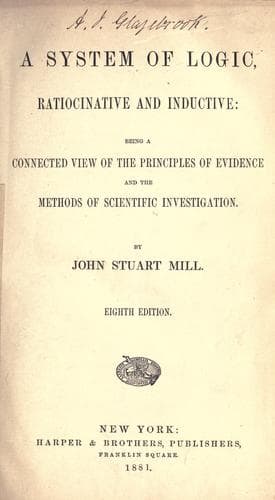
A System of Logic, Ratiocinative and InductiveMill, John Stuart
PhilosophyPhilosophy
A System of Logic, Ratiocinative and Inductive
Mill, John Stuart
Knowledge, Theory of; Logic; Science -- Methodology
Not only is the process by which an individual astronomical fact was thus
ascertained, exactly similar to those by which the same science
establishes its general truths, but also (as we have shown to be the case
in all legitimate reasoning) a general proposition might have been
concluded instead of a single fact. In strictness, indeed, the result of
the reasoning _is_ a general proposition; a theorem respecting the
distance, not of the moon in particular, but of any inaccessible object;
showing in what relation that distance stands to certain other quantities.
And although the moon is almost the only heavenly body the distance of
which from the earth can really be thus ascertained, this is merely owing
to the accidental circumstances of the other heavenly bodies, which render
them incapable of affording such data as the application of the theorem
requires; for the theorem itself is as true of them as it is of the
moon.(100)
We shall fall into no error, then, if in treating of Induction, we limit
our attention to the establishment of general propositions. The principles
and rules of Induction as directed to this end, are the principles and
rules of all Induction; and the logic of Science is the universal Logic,
applicable to all inquiries in which man can engage.
Chapter II.
Of Inductions Improperly So Called.
§ 1. Induction, then, is that operation of the mind, by which we infer
that what we know to be true in a particular case or cases, will be true
in all cases which resemble the former in certain assignable respects. In
other words, Induction is the process by which we conclude that what is
true of certain individuals of a class is true of the whole class, or that
what is true at certain times will be true in similar circumstances at all
times.
This definition excludes from the meaning of the term Induction, various
logical operations, to which it is not unusual to apply that name.
Public-domain text, read in full here on John Shaqi.
Reviews
Reviews
No reviews yet
Be the first to share your thoughts on this work.
Elsewhere in the archive
Join the Discussion
Join the discussion
Sign in to leave a comment or review.
Sign InorCreate an account