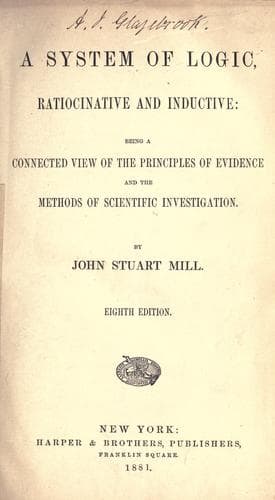
A System of Logic, Ratiocinative and InductiveMill, John Stuart
PhilosophyPhilosophy
A System of Logic, Ratiocinative and Inductive
Mill, John Stuart
Knowledge, Theory of; Logic; Science -- Methodology
As we may sum up a definite number of singular propositions in one
proposition, which will be apparently, but not really, general, so we may
sum up a definite number of general propositions in one proposition, which
will be apparently, but not really, more general. If by a separate
induction applied to every distinct species of animals, it has been
established that each possesses a nervous system, and we affirm thereupon
that all animals have a nervous system; this looks like a generalization,
though as the conclusion merely affirms of all what has already been
affirmed of each, it seems to tell us nothing but what we knew before. A
distinction, however, must be made. If in concluding that all animals have
a nervous system, we mean the same thing and no more as if we had said
“all known animals,” the proposition is not general, and the process by
which it is arrived at is not induction. But if our meaning is that the
observations made of the various species of animals have discovered to us
a law of animal nature, and that we are in a condition to say that a
nervous system will be found even in animals yet undiscovered, this indeed
is an induction; but in this case the general proposition contains more
than the sum of the special propositions from which it is inferred. The
distinction is still more forcibly brought out when we consider, that if
this real generalization be legitimate at all, its legitimacy probably
does not require that we should have examined without exception every
known species. It is the number and nature of the instances, and not their
being the whole of those which happen to be known, that makes them
sufficient evidence to prove a general law: while the more limited
assertion, which stops at all known animals, can not be made unless we
have rigorously verified it in every species. In like manner (to return to
a former example) we might have inferred, not that all _the_ planets, but
that all _planets_, shine by reflected light: the former is no induction;
the latter is an induction, and a bad one, being disproved by the case of
double stars—self-luminous bodies which are properly planets, since they
revolve round a centre.
Public-domain text, read in full here on John Shaqi.
Reviews
Reviews
No reviews yet
Be the first to share your thoughts on this work.
Elsewhere in the archive
Join the Discussion
Join the discussion
Sign in to leave a comment or review.
Sign InorCreate an account