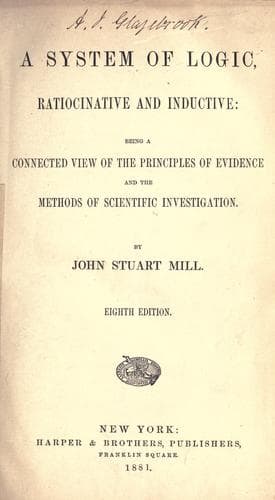
A System of Logic, Ratiocinative and InductiveMill, John Stuart
PhilosophyPhilosophy
A System of Logic, Ratiocinative and Inductive
Mill, John Stuart
Knowledge, Theory of; Logic; Science -- Methodology
§ 2. There are several processes used in mathematics which require to be
distinguished from Induction, being not unfrequently called by that name,
and being so far similar to Induction properly so called, that the
propositions they lead to are really general propositions. For example,
when we have proved with respect to the circle, that a straight line can
not meet it in more than two points, and when the same thing has been
successively proved of the ellipse, the parabola, and the hyperbola, it
may be laid down as a universal property of the sections of the cone. The
distinction drawn in the two previous examples can have no place here,
there being no difference between all _known_ sections of the cone and
_all_ sections, since a cone demonstrably can not be intersected by a
plane except in one of these four lines. It would be difficult, therefore,
to refuse to the proposition arrived at, the name of a generalization,
since there is no room for any generalization beyond it. But there is no
induction, because there is no inference: the conclusion is a mere summing
up of what was asserted in the various propositions from which it is
drawn. A case somewhat, though not altogether, similar, is the proof of a
geometrical theorem by means of a diagram. Whether the diagram be on paper
or only in the imagination, the demonstration (as formerly observed(101))
does not prove directly the general theorem; it proves only that the
conclusion, which the theorem asserts generally, is true of the particular
triangle or circle exhibited in the diagram; but since we perceive that in
the same way in which we have proved it of that circle, it might also be
proved of any other circle, we gather up into one general expression all
the singular propositions susceptible of being thus proved, and embody
them in a universal proposition. Having shown that the three angles of the
triangle ABC are together equal to two right angles, we conclude that this
is true of every other triangle, not because it is true of ABC, but for
the same reason which proved it to be true of ABC. If this were to be
called Induction, an appropriate name for it would be, induction by parity
of reasoning. But the term can not properly belong to it; the
characteristic quality of Induction is wanting, since the truth obtained,
though really general, is not believed on the evidence of particular
instances. We do not conclude that all triangles have the property because
some triangles have, but from the ulterior demonstrative evidence which
was the ground of our conviction in the particular instances.
Public-domain text, read in full here on John Shaqi.
Reviews
Reviews
No reviews yet
Be the first to share your thoughts on this work.
Elsewhere in the archive
Join the Discussion
Join the discussion
Sign in to leave a comment or review.
Sign InorCreate an account