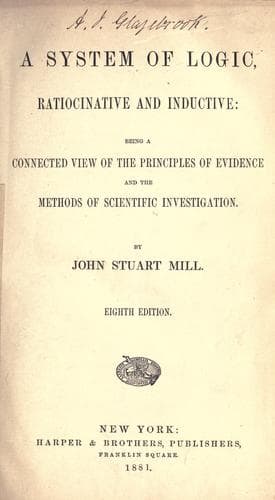
A System of Logic, Ratiocinative and InductiveMill, John Stuart
PhilosophyPhilosophy
A System of Logic, Ratiocinative and Inductive
Mill, John Stuart
Knowledge, Theory of; Logic; Science -- Methodology
There are nevertheless, in mathematics, some examples of so-called
Induction, in which the conclusion does bear the appearance of a
generalization grounded on some of the particular cases included in it. A
mathematician, when he has calculated a sufficient number of the terms of
an algebraical or arithmetical series to have ascertained what is called
the _law_ of the series, does not hesitate to fill up any number of the
succeeding terms without repeating the calculations. But I apprehend he
only does so when it is apparent from _a priori_ considerations (which
might be exhibited in the form of demonstration) that the mode of
formation of the subsequent terms, each from that which preceded it, must
be similar to the formation of the terms which have been already
calculated. And when the attempt has been hazarded without the sanction of
such general considerations, there are instances on record in which it has
led to false results.
It is said that Newton discovered the binomial theorem by induction; by
raising a binomial successively to a certain number of powers, and
comparing those powers with one another until he detected the relation in
which the algebraic formula of each power stands to the exponent of that
power, and to the two terms of the binomial. The fact is not improbable:
but a mathematician like Newton, who seemed to arrive _per saltum_ at
principles and conclusions that ordinary mathematicians only reached by a
succession of steps, certainly could not have performed the comparison in
question without being led by it to the _a priori_ ground of the law;
since any one who understands sufficiently the nature of multiplication to
venture upon multiplying several lines of symbols at one operation, can
not but perceive that in raising a binomial to a power, the co-efficients
must depend on the laws of permutation and combination: and as soon as
this is recognized, the theorem is demonstrated. Indeed, when once it was
seen that the law prevailed in a few of the lower powers, its identity
with the law of permutation would at once suggest the considerations which
prove it to obtain universally. Even, therefore, such cases as these, are
but examples of what I have called Induction by parity of reasoning, that
is, not really Induction, because not involving inference of a general
proposition from particular instances.
§ 3. There remains a third improper use of the term Induction, which it is
of real importance to clear up, because the theory of Induction has been,
in no ordinary degree, confused by it, and because the confusion is
exemplified in the most recent and elaborate treatise on the inductive
philosophy which exists in our language. The error in question is that of
confounding a mere description, by general terms, of a set of observed
phenomena, with an induction from them.
Public-domain text, read in full here on John Shaqi.
Reviews
Reviews
No reviews yet
Be the first to share your thoughts on this work.
Elsewhere in the archive
Join the Discussion
Join the discussion
Sign in to leave a comment or review.
Sign InorCreate an account