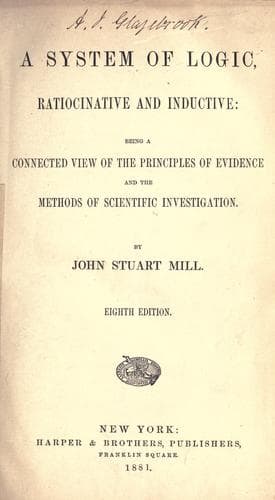
A System of Logic, Ratiocinative and InductiveMill, John Stuart
PhilosophyPhilosophy
A System of Logic, Ratiocinative and Inductive
Mill, John Stuart
Knowledge, Theory of; Logic; Science -- Methodology
The object of Kepler was to determine the real path described by each of
the planets, or let us say by the planet Mars (since it was of that body
that he first established the two of his three laws which did not require
a comparison of planets). To do this there was no other mode than that of
direct observation: and all which observation could do was to ascertain a
great number of the successive places of the planet; or rather, of its
apparent places. That the planet occupied successively all these
positions, or at all events, positions which produced the same impressions
on the eye, and that it passed from one of these to another insensibly,
and without any apparent breach of continuity; thus much the senses, with
the aid of the proper instruments, could ascertain. What Kepler did more
than this, was to find what sort of a curve these different points would
make, supposing them to be all joined together. He expressed the whole
series of the observed places of Mars by what Dr. Whewell calls the
general conception of an ellipse. This operation was far from being as
easy as that of the navigator who expressed the series of his observations
on successive points of the coast by the general conception of an island.
But it is the very same sort of operation; and if the one is not an
induction but a description, this must also be true of the other.
The only real induction concerned in the case, consisted in inferring that
because the observed places of Mars were correctly represented by points
in an imaginary ellipse, therefore Mars would continue to revolve in that
same ellipse; and in concluding (before the gap had been filled up by
further observations) that the positions of the planet during the time
which intervened between two observations, must have coincided with the
intermediate points of the curve. For these were facts which had not been
directly observed. They were inferences from the observations; facts
inferred, as distinguished from facts seen. But these inferences were so
far from being a part of Kepler’s philosophical operation, that they had
been drawn long before he was born. Astronomers had long known that the
planets periodically returned to the same places. When this had been
ascertained, there was no induction left for Kepler to make, nor did he
make any further induction. He merely applied his new conception to the
facts inferred, as he did to the facts observed. Knowing already that the
planets continued to move in the same paths; when he found that an ellipse
correctly represented the past path, he knew that it would represent the
future path. In finding a compendious expression for the one set of facts,
he found one for the other: but he found the expression only, not the
inference; nor did he (which is the true test of a general truth) add any
thing to the power of prediction already possessed.
Public-domain text, read in full here on John Shaqi.
Reviews
Reviews
No reviews yet
Be the first to share your thoughts on this work.
Elsewhere in the archive
Join the Discussion
Join the discussion
Sign in to leave a comment or review.
Sign InorCreate an account