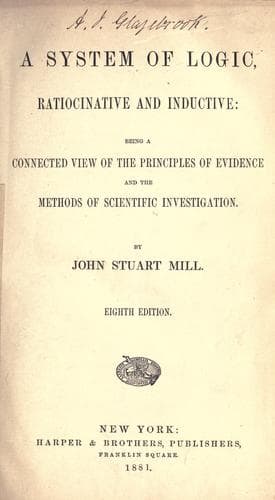
A System of Logic, Ratiocinative and InductiveMill, John Stuart
PhilosophyPhilosophy
A System of Logic, Ratiocinative and Inductive
Mill, John Stuart
Knowledge, Theory of; Logic; Science -- Methodology
§ 4. The descriptive operation which enables a number of details to be
summed up in a single proposition, Dr. Whewell, by an aptly chosen
expression, has termed the Colligation of Facts. In most of his
observations concerning that mental process I fully agree, and would
gladly transfer all that portion of his book into my own pages. I only
think him mistaken in setting up this kind of operation, which according
to the old and received meaning of the term, is not induction at all, as
the type of induction generally; and laying down, throughout his work, as
principles of induction, the principles of mere colligation.
Dr. Whewell maintains that the general proposition which binds together
the particular facts, and makes them, as it were, one fact, is not the
mere sum of those facts, but something more, since there is introduced a
conception of the mind, which did not exist in the facts themselves. “The
particular facts,” says he,(102) “are not merely brought together, but
there is a new element added to the combination by the very act of thought
by which they are combined.... When the Greeks, after long observing the
motions of the planets, saw that these motions might be rightly considered
as produced by the motion of one wheel revolving in the inside of another
wheel, these wheels were creations of their minds, added to the facts
which they perceived by sense. And even if the wheels were no longer
supposed to be material, but were reduced to mere geometrical spheres or
circles, they were not the less products of the mind alone—something
additional to the facts observed. The same is the case in all other
discoveries. The facts are known, but they are insulated and unconnected,
till the discoverer supplies from his own store a principle of connection.
The pearls are there, but they will not hang together till some one
provides the string.”
Public-domain text, read in full here on John Shaqi.
Reviews
Reviews
No reviews yet
Be the first to share your thoughts on this work.
Elsewhere in the archive
Join the Discussion
Join the discussion
Sign in to leave a comment or review.
Sign InorCreate an account