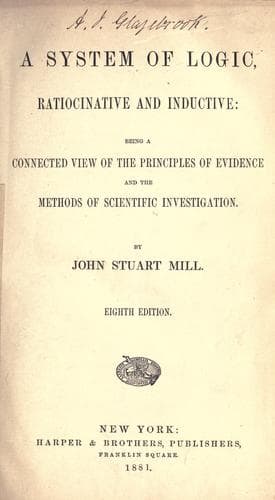
A System of Logic, Ratiocinative and InductiveMill, John Stuart
PhilosophyPhilosophy
A System of Logic, Ratiocinative and Inductive
Mill, John Stuart
Knowledge, Theory of; Logic; Science -- Methodology
Dr. Whewell calls nothing Induction where there is not a new mental
conception introduced, and every thing induction where there is. But this
is to confound two very different things, Invention and Proof. The
introduction of a new conception belongs to Invention: and invention may
be required in any operation, but is the essence of none. A new conception
may be introduced for descriptive purposes, and so it may for inductive
purposes. But it is so far from constituting induction, that induction
does not necessarily stand in need of it. Most inductions require no
conception but what was present in every one of the particular instances
on which the induction is grounded. That all men are mortal is surely an
inductive conclusion; yet no new conception is introduced by it. Whoever
knows that any man has died, has all the conceptions involved in the
inductive generalization. But Dr. Whewell considers the process of
invention which consists in framing a new conception consistent with the
facts, to be not merely a necessary part of all induction, but the whole
of it.
The mental operation which extracts from a number of detached observations
certain general characters in which the observed phenomena resemble one
another, or resemble other known facts, is what Bacon, Locke, and most
subsequent metaphysicians, have understood by the word Abstraction. A
general expression obtained by abstraction, connecting known facts by
means of common characters, but without concluding from them to unknown,
may, I think, with strict logical correctness, be termed a Description;
nor do I know in what other way things can ever be described. My position,
however, does not depend on the employment of that particular word; I am
quite content to use Dr. Whewell’s term Colligation, or the more general
phrases, “mode of representing, or of expressing, phenomena:” provided it
be clearly seen that the process is not Induction, but something radically
different.
What more may usefully be said on the subject of Colligation, or of the
correlative expression invented by Dr. Whewell, the Explication of
Conceptions, and generally on the subject of ideas and mental
representations as connected with the study of facts, will find a more
appropriate place in the Fourth Book, on the Operations Subsidiary to
Induction: to which I must refer the reader for the removal of any
difficulty which the present discussion may have left.
Chapter III.
Of The Ground Of Induction.
Public-domain text, read in full here on John Shaqi.
Reviews
Reviews
No reviews yet
Be the first to share your thoughts on this work.
Elsewhere in the archive
Join the Discussion
Join the discussion
Sign in to leave a comment or review.
Sign InorCreate an account