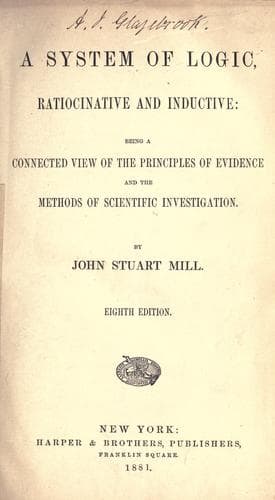
A System of Logic, Ratiocinative and InductiveMill, John Stuart
PhilosophyPhilosophy
A System of Logic, Ratiocinative and Inductive
Mill, John Stuart
Knowledge, Theory of; Logic; Science -- Methodology
§ 1. Induction properly so called, as distinguished from those mental
operations, sometimes, though improperly, designated by the name, which I
have attempted in the preceding chapter to characterize, may, then, be
summarily defined as Generalization from Experience. It consists in
inferring from some individual instances in which a phenomenon is observed
to occur, that it occurs in all instances of a certain class; namely, in
all which _resemble_ the former, in what are regarded as the material
circumstances.
In what way the material circumstances are to be distinguished from those
which are immaterial, or why some of the circumstances are material and
others not so, we are not yet ready to point out. We must first observe,
that there is a principle implied in the very statement of what Induction
is; an assumption with regard to the course of nature and the order of the
universe; namely, that there are such things in nature as parallel cases;
that what happens once, will, under a sufficient degree of similarity of
circumstances, happen again, and not only again, but as often as the same
circumstances recur. This, I say, is an assumption, involved in every case
of induction. And, if we consult the actual course of nature, we find that
the assumption is warranted. The universe, so far as known to us, is so
constituted, that whatever is true in any one case, is true in all cases
of a certain description; the only difficulty is, to find what
description.
This universal fact, which is our warrant for all inferences from
experience, has been described by different philosophers in different
forms of language: that the course of nature is uniform; that the universe
is governed by general laws; and the like. One of the most usual of these
modes of expression, but also one of the most inadequate, is that which
has been brought into familiar use by the metaphysicians of the school of
Reid and Stewart. The disposition of the human mind to generalize from
experience—a propensity considered by these philosophers as an instinct of
our nature—they usually describe under some such name as “our intuitive
conviction that the future will resemble the past.” Now it has been well
pointed out by Mr. Bailey,(107) that (whether the tendency be or not an
original and ultimate element of our nature), Time, in its modifications
of past, present, and future, has no concern either with the belief
itself, or with the grounds of it. We believe that fire will burn
to-morrow, because it burned to-day and yesterday; but we believe, on
precisely the same grounds, that it burned before we were born, and that
it burns this very day in Cochin-China. It is not from the past to the
future, as past and future, that we infer, but from the known to the
unknown; from facts observed to facts unobserved; from what we have
perceived, or been directly conscious of, to what has not come within our
experience. In this last predicament is the whole region of the future;
Public-domain text, read in full here on John Shaqi.
Reviews
Reviews
No reviews yet
Be the first to share your thoughts on this work.
Elsewhere in the archive
Join the Discussion
Join the discussion
Sign in to leave a comment or review.
Sign InorCreate an account