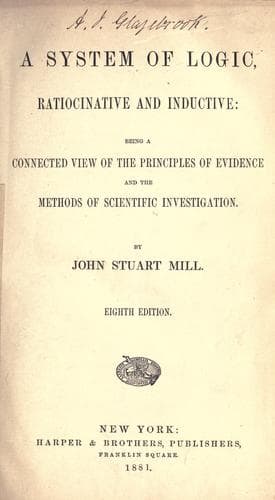
A System of Logic, Ratiocinative and InductiveMill, John Stuart
PhilosophyPhilosophy
A System of Logic, Ratiocinative and Inductive
Mill, John Stuart
Knowledge, Theory of; Logic; Science -- Methodology
I have used the words concrete and abstract in the sense annexed to them
by the schoolmen, who, notwithstanding the imperfections of their
philosophy, were unrivaled in the construction of technical language, and
whose definitions, in logic at least, though they never went more than a
little way into the subject, have seldom, I think, been altered but to be
spoiled. A practice, however, has grown up in more modern times, which, if
not introduced by Locke, has gained currency chiefly from his example, of
applying the expression “abstract name” to all names which are the result
of abstraction or generalization, and consequently to all general names,
instead of confining it to the names of attributes. The metaphysicians of
the Condillac school—whose admiration of Locke, passing over the
profoundest speculations of that truly original genius, usually fastens
with peculiar eagerness upon his weakest points—have gone on imitating him
in this abuse of language, until there is now some difficulty in restoring
the word to its original signification. A more wanton alteration in the
meaning of a word is rarely to be met with; for the expression _general
name_, the exact equivalent of which exists in all languages I am
acquainted with, was already available for the purpose to which _abstract_
has been misappropriated, while the misappropriation leaves that important
class of words, the names of attributes, without any compact distinctive
appellation. The old acceptation, however, has not gone so completely out
of use as to deprive those who still adhere to it of all chance of being
understood. By _abstract_, then, I shall always, in Logic proper, mean the
opposite of _concrete_; by an abstract name, the name of an attribute; by
a concrete name, the name of an object.
Do abstract names belong to the class of general, or to that of singular
names? Some of them are certainly general. I mean those which are names
not of one single and definite attribute, but of a class of attributes.
Such is the word _color_, which is a name common to whiteness, redness,
etc. Such is even the word whiteness, in respect of the different shades
of whiteness to which it is applied in common: the word magnitude, in
respect of the various degrees of magnitude and the various dimensions of
space; the word weight, in respect of the various degrees of weight. Such
also is the word _attribute_ itself, the common name of all particular
attributes. But when only one attribute, neither variable in degree nor in
kind, is designated by the name; as visibleness; tangibleness; equality;
squareness; milk-whiteness; then the name can hardly be considered
general; for though it denotes an attribute of many different objects, the
attribute itself is always conceived as one, not many.(9) To avoid
needless logomachies, the best course would probably be to consider these
names as neither general nor individual, and to place them in a class
apart.
Public-domain text, read in full here on John Shaqi.
Reviews
Reviews
No reviews yet
Be the first to share your thoughts on this work.
Join the Discussion
Join the discussion
Sign in to leave a comment or review.
Sign InorCreate an account