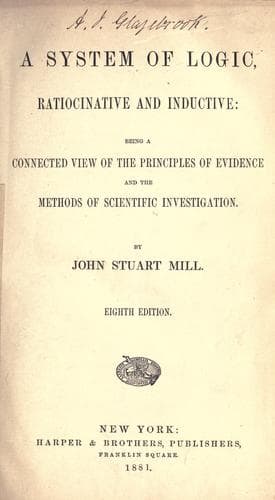
A System of Logic, Ratiocinative and InductiveMill, John Stuart
PhilosophyPhilosophy
A System of Logic, Ratiocinative and Inductive
Mill, John Stuart
Knowledge, Theory of; Logic; Science -- Methodology
facility with which the brain sums up a column of figures when it has been
long trained to calculation, is the result of a permanent new arrangement
of some of its material particles. We must, therefore, content ourselves
with what we know, and must include among the effects of causes, the
capacities given to objects of being causes of other effects. This
capacity is not a real thing existing in the objects; it is but a name for
our conviction that they will act in a particular manner when certain new
circumstances arise. We may invest this assurance of future events with a
fictitious objective existence, by calling it a state of the object. But
unless the state consists, as in the case of the gunpowder it does, in a
collocation of particles, it expresses no present fact; it is but the
contingent future fact brought back under another name.
It may be thought that this form of causation requires us to admit an
exception to the doctrine that the conditions of a phenomenon—the
antecedents required for calling it into existence—must all be found among
the facts immediately, not remotely, preceding its commencement. But what
we have arrived at is not a correction, it is only an explanation, of that
doctrine. In the enumeration of the conditions required for the occurrence
of any phenomenon, it always has to be included that objects must be
present, possessed of given properties. It is a condition of the
phenomenon explosion that an object should be present, of one or other of
certain kinds, which for that reason are called explosive. The presence of
one of these objects is a condition immediately precedent to the
explosion. The condition which is not immediately precedent is the cause
which produced, not the explosion, but the explosive property. The
conditions of the explosion itself were all present immediately before it
took place, and the general law, therefore, remains intact.
§ 6. It now remains to advert to a distinction which is of first-rate
importance both for clearing up the notion of cause, and for obviating a
very specious objection often made against the view which we have taken of
the subject.
Public-domain text, read in full here on John Shaqi.
Reviews
Reviews
No reviews yet
Be the first to share your thoughts on this work.
Elsewhere in the archive
Join the Discussion
Join the discussion
Sign in to leave a comment or review.
Sign InorCreate an account