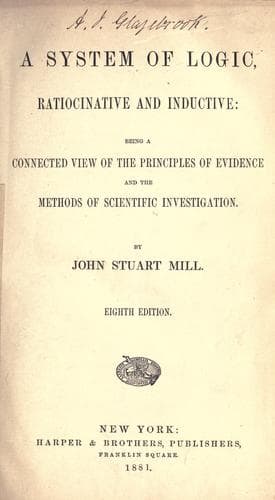
A System of Logic, Ratiocinative and InductiveMill, John Stuart
PhilosophyPhilosophy
A System of Logic, Ratiocinative and Inductive
Mill, John Stuart
Knowledge, Theory of; Logic; Science -- Methodology
When we define the cause of any thing (in the only sense in which the
present inquiry has any concern with causes) to be “the antecedent which
it invariably follows,” we do not use this phrase as exactly synonymous
with “the antecedent which it invariably _has_ followed in our past
experience.” Such a mode of conceiving causation would be liable to the
objection very plausibly urged by Dr. Reid, namely, that according to this
doctrine night must be the cause of day, and day the cause of night; since
these phenomena have invariably succeeded one another from the beginning
of the world. But it is necessary to our using the word cause, that we
should believe not only that the antecedent always _has_ been followed by
the consequent, but that, as long as the present constitution of
things(116) endures, it always _will_ be so. And this would not be true of
day and night. We do not believe that night will be followed by day under
all imaginable circumstances, but only that it will be so _provided_ the
sun rises above the horizon. If the sun ceased to rise, which, for aught
we know, may be perfectly compatible with the general laws of matter,
night would be, or might be, eternal. On the other hand, if the sun is
above the horizon, his light not extinct, and no opaque body between us
and him, we believe firmly that unless a change takes place in the
properties of matter, this combination of antecedents will be followed by
the consequent, day; that if the combination of antecedents could be
indefinitely prolonged, it would be always day; and that if the same
combination had always existed, it would always have been day, quite
independently of night as a previous condition. Therefore is it that we do
not call night the cause, nor even a condition, of day. The existence of
the sun (or some such luminous body), and there being no opaque medium in
a straight line(117) between that body and the part of the earth where we
are situated, are the sole conditions; and the union of these, without the
addition of any superfluous circumstance, constitutes the cause. This is
what writers mean when they say that the notion of cause involves the idea
of necessity. If there be any meaning which confessedly belongs to the
term necessity, it is _unconditionalness_. That which is necessary, that
which _must_ be, means that which will be, whatever supposition we may
make in regard to all other things. The succession of day and night
evidently is not necessary in this sense. It is conditional on the
occurrence of other antecedents. That which will be followed by a given
consequent when, and only when, some third circumstance also exists, is
not the cause, even though no case should ever have occurred in which the
phenomenon took place without it.
Public-domain text, read in full here on John Shaqi.
Reviews
Reviews
No reviews yet
Be the first to share your thoughts on this work.
Elsewhere in the archive
Join the Discussion
Join the discussion
Sign in to leave a comment or review.
Sign InorCreate an account