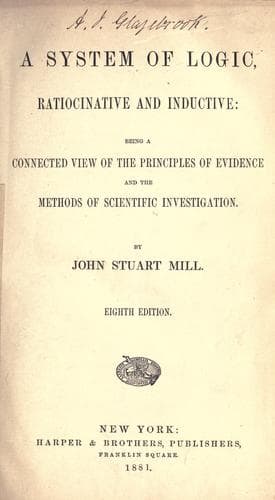
A System of Logic, Ratiocinative and InductiveMill, John Stuart
PhilosophyPhilosophy
A System of Logic, Ratiocinative and Inductive
Mill, John Stuart
Knowledge, Theory of; Logic; Science -- Methodology
A non-connotative term is one which signifies a subject only, or an
attribute only. A connotative term is one which denotes a subject, and
implies an attribute. By a subject is here meant any thing which possesses
attributes. Thus John, or London, or England, are names which signify a
subject only. Whiteness, length, virtue, signify an attribute only. None
of these names, therefore, are connotative. But _white_, _long_,
_virtuous_, are connotative. The word white, denotes all white things, as
snow, paper, the foam of the sea, etc., and implies, or in the language of
the schoolmen, _connotes_,(10) the attribute _whiteness_. The word white
is not predicated of the attribute, but of the subjects, snow, etc.; but
when we predicate it of them, we convey the meaning that the attribute
whiteness belongs to them. The same may be said of the other words above
cited. Virtuous, for example, is the name of a class, which includes
Socrates, Howard, the Man of Ross, and an undefinable number of other
individuals, past, present, and to come. These individuals, collectively
and severally, can alone be said with propriety to be denoted by the word:
of them alone can it properly be said to be a name. But it is a name
applied to all of them in consequence of an attribute which they are
supposed to possess in common, the attribute which has received the name
of virtue. It is applied to all beings that are considered to possess this
attribute; and to none which are not so considered.
All concrete general names are connotative. The word _man_, for example,
denotes Peter, Jane, John, and an indefinite number of other individuals,
of whom, taken as a class, it is the name. But it is applied to them,
because they possess, and to signify that they possess, certain
attributes. These seem to be, corporeity, animal life, rationality, and a
certain external form, which for distinction we call the human. Every
existing thing, which possessed all these attributes, would be called a
man; and any thing which possessed none of them, or only one, or two, or
even three of them without the fourth, would not be so called. For
example, if in the interior of Africa there were to be discovered a race
of animals possessing reason equal to that of human beings, but with the
form of an elephant, they would not be called men. Swift’s Houyhnhnms
would not be so called. Or if such newly-discovered beings possessed the
form of man without any vestige of reason, it is probable that some other
name than that of man would be found for them. How it happens that there
can be any doubt about the matter, will appear hereafter. The word _man_,
therefore, signifies all these attributes, and all subjects which possess
these attributes. But it can be predicated only of the subjects. What we
call men, are the subjects, the individual Stiles and Nokes; not the
qualities by which their humanity is constituted. The name, therefore, is
Public-domain text, read in full here on John Shaqi.
Reviews
Reviews
No reviews yet
Be the first to share your thoughts on this work.
Join the Discussion
Join the discussion
Sign in to leave a comment or review.
Sign InorCreate an account