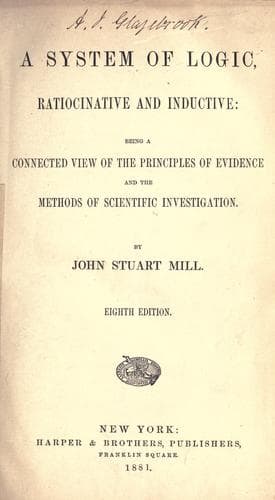
A System of Logic, Ratiocinative and InductiveMill, John Stuart
PhilosophyPhilosophy
A System of Logic, Ratiocinative and Inductive
Mill, John Stuart
Knowledge, Theory of; Logic; Science -- Methodology
When we predicate of any thing its proper name; when we say, pointing to a
man, this is Brown or Smith, or pointing to a city, that it is York, we do
not, merely by so doing, convey to the reader any information about them,
except that those are their names. By enabling him to identify the
individuals, we may connect them with information previously possessed by
him; by saying, This is York, we may tell him that it contains the
Minster. But this is in virtue of what he has previously heard concerning
York; not by any thing implied in the name. It is otherwise when objects
are spoken of by connotative names. When we say, The town is built of
marble, we give the hearer what may be entirely new information, and this
merely by the signification of the many-worded connotative name, “built of
marble.” Such names are not signs of the mere objects, invented because we
have occasion to think and speak of those objects individually; but signs
which accompany an attribute; a kind of livery in which the attribute
clothes all objects which are recognized as possessing it. They are not
mere marks, but more, that is to say, significant marks; and the
connotation is what constitutes their significance.
As a proper name is said to be the name of the one individual which it is
predicated of, so (as well from the importance of adhering to analogy, as
for the other reasons formerly assigned) a connotative name ought to be
considered a name of all the various individuals which it is predicable
of, or in other words _denotes_, and not of what it connotes. But by
learning what things it is a name of, we do not learn the meaning of the
name: for to the same thing we may, with equal propriety, apply many
names, not equivalent in meaning. Thus, I call a certain man by the name
Sophroniscus: I call him by another name, The father of Socrates. Both
these are names of the same individual, but their meaning is altogether
different; they are applied to that individual for two different purposes:
the one, merely to distinguish him from other persons who are spoken of;
the other to indicate a fact relating to him, the fact that Socrates was
his son. I further apply to him these other expressions: a man, a Greek,
an Athenian, a sculptor, an old man, an honest man, a brave man. All these
are, or may be, names of Sophroniscus, not indeed of him alone, but of him
and each of an indefinite number of other human beings. Each of these
names is applied to Sophroniscus for a different reason, and by each
whoever understands its meaning is apprised of a distinct fact or number
of facts concerning him; but those who knew nothing about the names except
that they were applicable to Sophroniscus, would be altogether ignorant of
their meaning. It is even possible that I might know every single
individual of whom a given name could be with truth affirmed, and yet
could not be said to know the meaning of the name. A child knows who are
Public-domain text, read in full here on John Shaqi.
Reviews
Reviews
No reviews yet
Be the first to share your thoughts on this work.
Join the Discussion
Join the discussion
Sign in to leave a comment or review.
Sign InorCreate an account