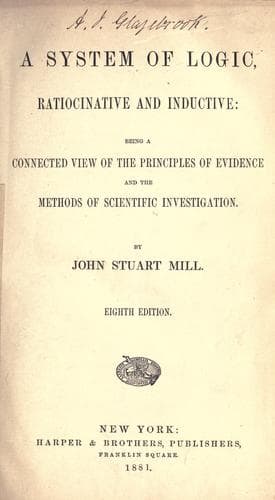
A System of Logic, Ratiocinative and InductiveMill, John Stuart
PhilosophyPhilosophy
A System of Logic, Ratiocinative and Inductive
Mill, John Stuart
Knowledge, Theory of; Logic; Science -- Methodology
Now, there are philosophers who have argued as follows: If we conceive an
orange to be divested of its natural color without acquiring any new one;
to lose its softness without becoming hard, its roundness without becoming
square or pentagonal, or of any other regular or irregular figure
whatever; to be deprived of size, of weight, of taste, of smell; to lose
all its mechanical and all its chemical properties, and acquire no new
ones; to become, in short, invisible, intangible, imperceptible not only
by all our senses, but by the senses of all other sentient beings, real or
possible; nothing, say these thinkers, would remain. For of what nature,
they ask, could be the residuum? and by what token could it manifest its
presence? To the unreflecting its existence seems to rest on the evidence
of the senses. But to the senses nothing is apparent except the
sensations. We know, indeed, that these sensations are bound together by
some law; they do not come together at random, but according to a
systematic order, which is part of the order established in the universe.
When we experience one of these sensations, we usually experience the
others also, or know that we have it in our power to experience them. But
a fixed law of connection, making the sensations occur together, does not,
say these philosophers, necessarily require what is called a substratum to
support them. The conception of a substratum is but one of many possible
forms in which that connection presents itself to our imagination; a mode
of, as it were, realizing the idea. If there be such a substratum, suppose
it at this instant miraculously annihilated, and let the sensations
continue to occur in the same order, and how would the substratum be
missed? By what signs should we be able to discover that its existence had
terminated? Should we not have as much reason to believe that it still
existed as we now have? And if we should not then be warranted in
believing it, how can we be so now? A body, therefore, according to these
metaphysicians, is not any thing intrinsically different from the
sensations which the body is said to produce in us; it is, in short, a set
of sensations, or rather, of possibilities of sensation, joined together
according to a fixed law.
Public-domain text, read in full here on John Shaqi.
Reviews
Reviews
No reviews yet
Be the first to share your thoughts on this work.
Join the Discussion
Join the discussion
Sign in to leave a comment or review.
Sign InorCreate an account