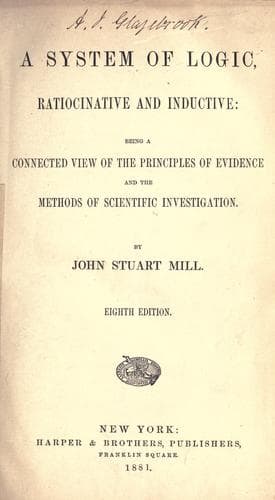
A System of Logic, Ratiocinative and InductiveMill, John Stuart
PhilosophyPhilosophy
A System of Logic, Ratiocinative and Inductive
Mill, John Stuart
Knowledge, Theory of; Logic; Science -- Methodology
The longest of the additions belongs to the chapter on Causation, and is a
discussion of the question how far, if at all, the ordinary mode of
stating the law of Cause and Effect requires modification to adapt it to
the new doctrine of the Conservation of Force—a point still more fully and
elaborately treated in Mr. Bain’s work.
INTRODUCTION.
§ 1. There is as great diversity among authors in the modes which they
have adopted of defining logic, as in their treatment of the details of
it. This is what might naturally be expected on any subject on which
writers have availed themselves of the same language as a means of
delivering different ideas. Ethics and jurisprudence are liable to the
remark in common with logic. Almost every writer having taken a different
view of some of the particulars which these branches of knowledge are
usually understood to include; each has so framed his definition as to
indicate beforehand his own peculiar tenets, and sometimes to beg the
question in their favor.
This diversity is not so much an evil to be complained of, as an
inevitable and in some degree a proper result of the imperfect state of
those sciences. It is not to be expected that there should be agreement
about the definition of any thing, until there is agreement about the
thing itself. To define, is to select from among all the properties of a
thing, those which shall be understood to be designated and declared by
its name; and the properties must be well known to us before we can be
competent to determine which of them are fittest to be chosen for this
purpose. Accordingly, in the case of so complex an aggregation of
particulars as are comprehended in any thing which can be called a
science, the definition we set out with is seldom that which a more
extensive knowledge of the subject shows to be the most appropriate. Until
we know the particulars themselves, we can not fix upon the most correct
and compact mode of circumscribing them by a general description. It was
not until after an extensive and accurate acquaintance with the details of
chemical phenomena, that it was found possible to frame a rational
definition of chemistry; and the definition of the science of life and
organization is still a matter of dispute. So long as the sciences are
imperfect, the definitions must partake of their imperfection; and if the
former are progressive, the latter ought to be so too. As much, therefore,
as is to be expected from a definition placed at the commencement of a
subject, is that it should define the scope of our inquiries: and the
definition which I am about to offer of the science of logic, pretends to
nothing more than to be a statement of the question which I have put to
myself, and which this book is an attempt to resolve. The reader is at
liberty to object to it as a definition of logic; but it is at all events
a correct definition of the subject of this volume.
Public-domain text, read in full here on John Shaqi.
Reviews
Reviews
No reviews yet
Be the first to share your thoughts on this work.
Join the Discussion
Join the discussion
Sign in to leave a comment or review.
Sign InorCreate an account