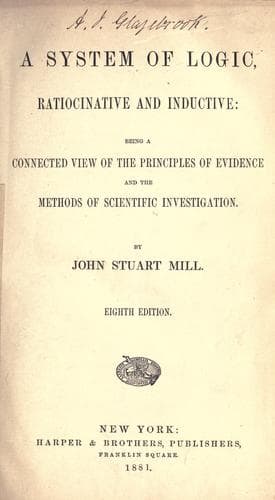
A System of Logic, Ratiocinative and InductiveMill, John Stuart
PhilosophyPhilosophy
A System of Logic, Ratiocinative and Inductive
Mill, John Stuart
Knowledge, Theory of; Logic; Science -- Methodology
As there may with propriety be said to be a relation between any two
things to which two correlative names are or may be given, we may expect
to discover what constitutes a relation in general, if we enumerate the
principal cases in which mankind have imposed correlative names, and
observe what these cases have in common.
What, then, is the character which is possessed in common by states of
circumstances so heterogeneous and discordant as these: one thing _like_
another; one thing _unlike_ another; one thing _near_ another; one thing
_far from_ another; one thing _before_, _after_, _along with_ another; one
thing _greater_, _equal_, _less_, than another; one thing the _cause_ of
another, the _effect_ of another; one person the _master_, _servant_,
_child_, _parent_, _debtor_, _creditor_, _sovereign_, _subject_,
_attorney_, _client_, of another, and so on?
Omitting, for the present, the case of Resemblance, (a relation which
requires to be considered separately,) there seems to be one thing common
to all these cases, and only one; that in each of them there exists or
occurs, or has existed or occurred, or may be expected to exist or occur,
some fact or phenomenon, into which the two things which are said to be
related to each other, both enter as parties concerned. This fact, or
phenomenon, is what the Aristotelian logicians called the _fundamentum
relationis_. Thus in the relation of greater and less between two
magnitudes, the _fundamentum relationis_ is the fact that one of the two
magnitudes could, under certain conditions, be included in, without
entirely filling, the space occupied by the other magnitude. In the
relation of master and servant, the _fundamentum relationis_ is the fact
that the one has undertaken, or is compelled, to perform certain services
for the benefit and at the bidding of the other. Examples might be
indefinitely multiplied; but it is already obvious that whenever two
things are said to be related, there is some fact, or series of facts,
into which they both enter; and that whenever any two things are involved
in some one fact, or series of facts, we may ascribe to those two things a
mutual relation grounded on the fact. Even if they have nothing in common
but what is common to all things, that they are members of the universe,
we call that a relation, and denominate them fellow-creatures,
fellow-beings, or fellow-denizens of the universe. But in proportion as
the fact into which the two objects enter as parts is of a more special
and peculiar, or of a more complicated nature, so also is the relation
grounded upon it. And there are as many conceivable relations as there are
conceivable kinds of fact in which two things can be jointly concerned.
Public-domain text, read in full here on John Shaqi.
Reviews
Reviews
No reviews yet
Be the first to share your thoughts on this work.
Join the Discussion
Join the discussion
Sign in to leave a comment or review.
Sign InorCreate an account