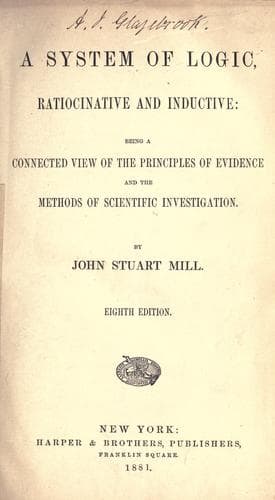
A System of Logic, Ratiocinative and InductiveMill, John Stuart
PhilosophyPhilosophy
A System of Logic, Ratiocinative and Inductive
Mill, John Stuart
Knowledge, Theory of; Logic; Science -- Methodology
4th, and last. The Successions and Co-existences, the Likenesses and
Unlikenesses, between feelings or states of consciousness. Those
relations, when considered as subsisting between other things, exist in
reality only between the states of consciousness which those things, if
bodies, excite, if minds, either excite or experience.
This, until a better can be suggested, may serve as a substitute for the
Categories of Aristotle considered as a classification of Existences. The
practical application of it will appear when we commence the inquiry into
the Import of Propositions; in other words, when we inquire what it is
which the mind actually believes, when it gives what is called its assent
to a proposition.
These four classes comprising, if the classification be correct, all
Namable Things, these or some of them must of course compose the
signification of all names: and of these, or some of them, is made up
whatever we call a fact.
For distinction’s sake, every fact which is solely composed of feelings or
states of consciousness considered as such, is often called a
Psychological or Subjective fact; while every fact which is composed,
either wholly or in part, of something different from these, that is, of
substances and attributes, is called an Objective fact. We may say, then,
that every objective fact is grounded on a corresponding subjective one;
and has no meaning to us (apart from the subjective fact which corresponds
to it), except as a name for the unknown and inscrutable process by which
that subjective or psychological fact is brought to pass.
Chapter IV.
Of Propositions.
§ 1. In treating of Propositions, as already in treating of Names, some
considerations of a comparatively elementary nature respecting their form
and varieties must be premised, before entering upon that analysis of the
import conveyed by them, which is the real subject and purpose of this
preliminary book.
Public-domain text, read in full here on John Shaqi.
Reviews
Reviews
No reviews yet
Be the first to share your thoughts on this work.
Elsewhere in the archive
Join the Discussion
Join the discussion
Sign in to leave a comment or review.
Sign InorCreate an account