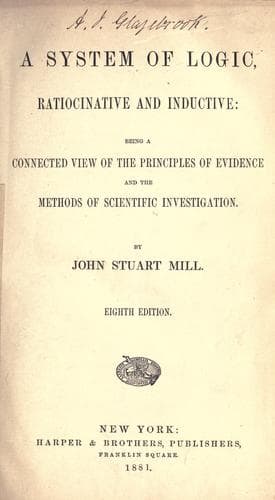
A System of Logic, Ratiocinative and InductiveMill, John Stuart
PhilosophyPhilosophy
A System of Logic, Ratiocinative and Inductive
Mill, John Stuart
Knowledge, Theory of; Logic; Science -- Methodology
A proposition, we have before said, is a portion of discourse in which a
predicate is affirmed or denied of a subject. A predicate and a subject
are all that is necessarily required to make up a proposition: but as we
can not conclude from merely seeing two names put together, that they are
a predicate and a subject, that is, that one of them is intended to be
affirmed or denied of the other, it is necessary that there should be some
mode or form of indicating that such is the intention; some sign to
distinguish a predication from any other kind of discourse. This is
sometimes done by a slight alteration of one of the words, called an
_inflection_; as when we say, Fire burns; the change of the second word
from _burn_ to _burns_ showing that we mean to affirm the predicate burn
of the subject fire. But this function is more commonly fulfilled by the
word _is_, when an affirmation is intended, _is not_, when a negation; or
by some other part of the verb _to be_. The word which thus serves the
purpose of a sign of predication is called, as we formerly observed, the
_copula_. It is important that there should be no indistinctness in our
conception of the nature and office of the copula; for confused notions
respecting it are among the causes which have spread mysticism over the
field of logic, and perverted its speculations into logomachies.
It is apt to be supposed that the copula is something more than a mere
sign of predication; that it also signifies existence. In the proposition,
Socrates is just, it may seem to be implied not only that the quality
_just_ can be affirmed of Socrates, but moreover that Socrates _is_, that
is to say, exists. This, however, only shows that there is an ambiguity in
the word _is_; a word which not only performs the function of the copula
in affirmations, but has also a meaning of its own, in virtue of which it
may itself be made the predicate of a proposition. That the employment of
it as a copula does not necessarily include the affirmation of existence,
appears from such a proposition as this, A centaur is a fiction of the
poets; where it can not possibly be implied that a centaur exists, since
the proposition itself expressly asserts that the thing has no real
existence.
Public-domain text, read in full here on John Shaqi.
Reviews
Reviews
No reviews yet
Be the first to share your thoughts on this work.
Elsewhere in the archive
Join the Discussion
Join the discussion
Sign in to leave a comment or review.
Sign InorCreate an account