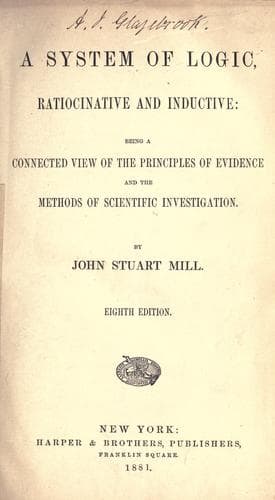
A System of Logic, Ratiocinative and InductiveMill, John Stuart
PhilosophyPhilosophy
A System of Logic, Ratiocinative and Inductive
Mill, John Stuart
Knowledge, Theory of; Logic; Science -- Methodology
As has been well remarked by Archbishop Whately and others, the
disjunctive form is resolvable into the conditional; every disjunctive
proposition being equivalent to two or more conditional ones. “Either A is
B or C is D,” means, “if A is not B, C is D; and if C is not D, A is B.”
All hypothetical propositions, therefore, though disjunctive in form, are
conditional in meaning; and the words hypothetical and conditional may be,
as indeed they generally are, used synonymously. Propositions in which the
assertion is not dependent on a condition, are said, in the language of
logicians, to be _categorical_.
A hypothetical proposition is not, like the pretended complex propositions
which we previously considered, a mere aggregation of simple propositions.
The simple propositions which form part of the words in which it is
couched, form no part of the assertion which it conveys. When we say, If
the Koran comes from God, Mohammed is the prophet of God, we do not intend
to affirm either that the Koran does come from God, or that Mohammed is
really his prophet. Neither of these simple propositions may be true, and
yet the truth of the hypothetical proposition may be indisputable. What is
asserted is not the truth of either of the propositions, but the
inferribility of the one from the other. What, then, is the subject, and
what the predicate of the hypothetical proposition? “The Koran” is not the
subject of it, nor is “Mohammed:” for nothing is affirmed or denied either
of the Koran or of Mohammed. The real subject of the predication is the
entire proposition, “Mohammed is the prophet of God;” and the affirmation
is, that this is a legitimate inference from the proposition, “The Koran
comes from God.” The subject and predicate, therefore, of a hypothetical
proposition are names of propositions. The subject is some one
proposition. The predicate is a general relative name applicable to
propositions; of this form—“an inference from so and so.” A fresh instance
is here afforded of the remark, that particles are abbreviations; since
“_If_ A is B, C is D,” is found to be an abbreviation of the following:
“The proposition C is D, is a legitimate inference from the proposition A
is B.”
Public-domain text, read in full here on John Shaqi.
Reviews
Reviews
No reviews yet
Be the first to share your thoughts on this work.
Elsewhere in the archive