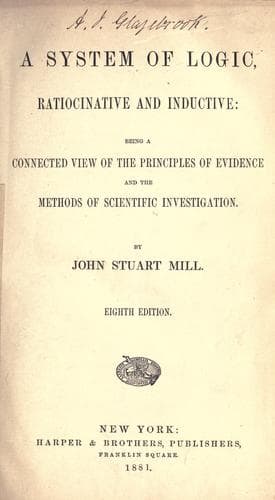
A System of Logic, Ratiocinative and InductiveMill, John Stuart
PhilosophyPhilosophy
A System of Logic, Ratiocinative and Inductive
Mill, John Stuart
Knowledge, Theory of; Logic; Science -- Methodology
The distinction, therefore, between hypothetical and categorical
propositions is not so great as it at first appears. In the conditional,
as well as in the categorical form, one predicate is affirmed of one
subject, and no more: but a conditional proposition is a proposition
concerning a proposition; the subject of the assertion is itself an
assertion. Nor is this a property peculiar to hypothetical propositions.
There are other classes of assertions concerning propositions. Like other
things, a proposition has attributes which may be predicated of it. The
attribute predicated of it in a hypothetical proposition, is that of being
an inference from a certain other proposition. But this is only one of
many attributes that might be predicated. We may say, That the whole is
greater than its part, is an axiom in mathematics: That the Holy Ghost
proceeds from the Father alone, is a tenet of the Greek Church: The
doctrine of the divine right of kings was renounced by Parliament at the
Revolution: The infallibility of the Pope has no countenance from
Scripture. In all these cases the subject of the predication is an entire
proposition. That which these different predicates are affirmed of, is
_the proposition_, “the whole is greater than its part;” _the
proposition_, “the Holy Ghost proceeds from the Father alone;” _the
proposition_, “kings have a divine right;” _the proposition_, “the Pope is
infallible.”
Seeing, then, that there is much less difference between hypothetical
propositions and any others, than one might be led to imagine from their
form, we should be at a loss to account for the conspicuous position which
they have been selected to fill in treatises on logic, if we did not
remember that what they predicate of a proposition, namely, its being an
inference from something else, is precisely that one of its attributes
with which most of all a logician is concerned.
§ 4. The next of the common divisions of Propositions is into Universal,
Particular, Indefinite, and Singular: a distinction founded on the degree
of generality in which the name, which is the subject of the proposition,
is to be understood. The following are examples:
_All men_ are mortal—Universal.
_Some men_ are mortal—Particular.
_Man_ is mortal—Indefinite.
_Julius Cæsar_ is mortal—Singular.
The proposition is Singular, when the subject is an individual name. The
individual name needs not be a proper name. “The Founder of Christianity
was crucified,” is as much a singular proposition as “Christ was
crucified.”
Public-domain text, read in full here on John Shaqi.
Reviews
Reviews
No reviews yet
Be the first to share your thoughts on this work.
Elsewhere in the archive
Join the Discussion
Join the discussion
Sign in to leave a comment or review.
Sign InorCreate an account