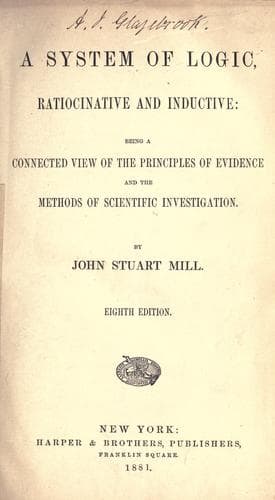
A System of Logic, Ratiocinative and InductiveMill, John Stuart
PhilosophyPhilosophy
A System of Logic, Ratiocinative and Inductive
Mill, John Stuart
Knowledge, Theory of; Logic; Science -- Methodology
necessary to animal life’ is a case of particular quantity; the meaning is
some sort of food, not necessarily all sorts. ‘Metal is requisite in order
to strength’ does not mean all kinds of metal. ‘Gold will make a way,’
means a portion of gold.”
When a general name stands for each and every individual which it is a
name of, or in other words, which it denotes, it is said by logicians to
be _distributed_, or taken distributively. Thus, in the proposition, All
men are mortal, the subject, Man, is distributed, because mortality is
affirmed of each and every man. The predicate, Mortal, is not distributed,
because the only mortals who are spoken of in the proposition are those
who happen to be men; while the word may, for aught that appears, and in
fact does, comprehend within it an indefinite number of objects besides
men. In the proposition, Some men are mortal, both the predicate and the
subject are undistributed. In the following, No men have wings, both the
predicate and the subject are distributed. Not only is the attribute of
having wings denied of the entire class Man, but that class is severed and
cast out from the whole of the class Winged, and not merely from some part
of that class.
This phraseology, which is of great service in stating and demonstrating
the rules of the syllogism, enables us to express very concisely the
definitions of a universal and a particular proposition. A universal
proposition is that of which the subject is distributed; a particular
proposition is that of which the subject is undistributed.
There are many more distinctions among propositions than those we have
here stated, some of them of considerable importance. But, for explaining
and illustrating these, more suitable opportunities will occur in the
sequel.
Chapter V.
Of The Import Of Propositions.
§ 1. An inquiry into the nature of propositions must have one of two
objects: to analyze the state of mind called Belief, or to analyze what is
believed. All language recognizes a difference between a doctrine or
opinion, and the fact of entertaining the opinion; between assent, and
what is assented to.
Logic, according to the conception here formed of it, has no concern with
the nature of the act of judging or believing; the consideration of that
act, as a phenomenon of the mind, belongs to another science.
Philosophers, however, from Descartes downward, and especially from the
era of Leibnitz and Locke, have by no means observed this distinction; and
would have treated with great disrespect any attempt to analyze the import
of Propositions, unless founded on an analysis of the act of Judgment. A
proposition, they would have said, is but the expression in words of a
Judgment. The thing expressed, not the mere verbal expression, is the
important matter. When the mind assents to a proposition, it judges. Let
us find out what the mind does when it judges, and we shall know what
propositions mean, and not otherwise.
Public-domain text, read in full here on John Shaqi.
Reviews
Reviews
No reviews yet
Be the first to share your thoughts on this work.
Elsewhere in the archive
Join the Discussion
Join the discussion
Sign in to leave a comment or review.
Sign InorCreate an account