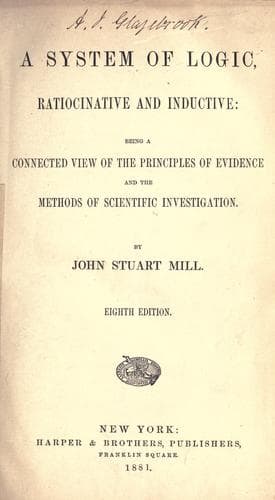
A System of Logic, Ratiocinative and InductiveMill, John Stuart
PhilosophyPhilosophy
A System of Logic, Ratiocinative and Inductive
Mill, John Stuart
Knowledge, Theory of; Logic; Science -- Methodology
Conformably to these views, almost all the writers on Logic in the last
two centuries, whether English, German, or French, have made their theory
of Propositions, from one end to the other, a theory of Judgments. They
considered a Proposition, or a Judgment, for they used the two words
indiscriminately, to consist in affirming or denying one _idea_ of
another. To judge, was to put two ideas together, or to bring one idea
under another, or to compare two ideas, or to perceive the agreement or
disagreement between two ideas: and the whole doctrine of Propositions,
together with the theory of Reasoning (always necessarily founded on the
theory of Propositions), was stated as if Ideas, or Conceptions, or
whatever other term the writer preferred as a name for mental
representations generally, constituted essentially the subject-matter and
substance of those operations.
It is, of course, true, that in any case of judgment, as for instance when
we judge that gold is yellow, a process takes place in our minds, of which
some one or other of these theories is a partially correct account. We
must have the idea of gold and the idea of yellow, and these two ideas
must be brought together in our mind. But in the first place, it is
evident that this is only a part of what takes place; for we may put two
ideas together without any act of belief; as when we merely imagine
something, such as a golden mountain; or when we actually disbelieve: for
in order even to disbelieve that Mohammed was an apostle of God, we must
put the idea of Mohammed and that of an apostle of God together. To
determine what it is that happens in the case of assent or dissent besides
putting two ideas together, is one of the most intricate of metaphysical
problems. But whatever the solution may be, we may venture to assert that
it can have nothing whatever to do with the import of propositions; for
this reason, that propositions (except sometimes when the mind itself is
the subject treated of) are not assertions respecting our ideas of things,
but assertions respecting the things themselves. In order to believe that
gold is yellow, I must, indeed, have the idea of gold, and the idea of
yellow, and something having reference to those ideas must take place in
my mind; but my belief has not reference to the ideas, it has reference to
the things. What I believe, is a fact relating to the outward thing, gold,
and to the impression made by that outward thing upon the human organs;
not a fact relating to my conception of gold, which would be a fact in my
mental history, not a fact of external nature. It is true, that in order
to believe this fact in external nature, another fact must take place in
my mind, a process must be performed upon my ideas; but so it must in
every thing else that I do. I can not dig the ground unless I have the
idea of the ground, and of a spade, and of all the other things I am
operating upon, and unless I put those ideas together.(30) But it would be
Public-domain text, read in full here on John Shaqi.
Reviews
Reviews
No reviews yet
Be the first to share your thoughts on this work.
Elsewhere in the archive
Join the Discussion
Join the discussion
Sign in to leave a comment or review.
Sign InorCreate an account