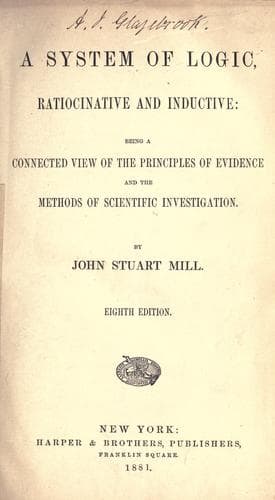
A System of Logic, Ratiocinative and InductiveMill, John Stuart
PhilosophyPhilosophy
A System of Logic, Ratiocinative and Inductive
Mill, John Stuart
Knowledge, Theory of; Logic; Science -- Methodology
a very ridiculous description of digging the ground to say that it is
putting one idea into another. Digging is an operation which is performed
upon the things themselves, though it can not be performed unless I have
in my mind the ideas of them. And in like manner, believing is an act
which has for its subject the facts themselves, though a previous mental
conception of the facts is an indispensable condition. When I say that
fire causes heat, do I mean that my idea of fire causes my idea of heat?
No: I mean that the natural phenomenon, fire, causes the natural
phenomenon, heat. When I mean to assert any thing respecting the ideas, I
give them their proper name, I call them ideas: as when I say, that a
child’s idea of a battle is unlike the reality, or that the ideas
entertained of the Deity have a great effect on the characters of mankind.
The notion that what is of primary importance to the logician in a
proposition, is the relation between the two _ideas_ corresponding to the
subject and predicate (instead of the relation between the two _phenomena_
which they respectively express), seems to me one of the most fatal errors
ever introduced into the philosophy of Logic; and the principal cause why
the theory of the science has made such inconsiderable progress during the
last two centuries. The treatises on Logic, and on the branches of Mental
Philosophy connected with Logic, which have been produced since the
intrusion of this cardinal error, though sometimes written by men of
extraordinary abilities and attainments, almost always tacitly imply a
theory that the investigation of truth consists in contemplating and
handling our ideas, or conceptions of things, instead of the things
themselves: a doctrine tantamount to the assertion, that the only mode of
acquiring knowledge of nature is to study it at second hand, as
represented in our own minds. Meanwhile, inquiries into every kind of
natural phenomena were incessantly establishing great and fruitful truths
on most important subjects, by processes upon which these views of the
nature of Judgment and Reasoning threw no light, and in which they
afforded no assistance whatever. No wonder that those who knew by
practical experience how truths are arrived at, should deem a science
futile, which consisted chiefly of such speculations. What has been done
for the advancement of Logic since these doctrines came into vogue, has
been done not by professed logicians, but by discoverers in the other
sciences; in whose methods of investigation many principles of logic, not
previously thought of, have successively come forth into light, but who
have generally committed the error of supposing that nothing whatever was
known of the art of philosophizing by the old logicians, because their
modern interpreters have written to so little purpose respecting it.
Public-domain text, read in full here on John Shaqi.
Reviews
Reviews
No reviews yet
Be the first to share your thoughts on this work.
Elsewhere in the archive
Join the Discussion
Join the discussion
Sign in to leave a comment or review.
Sign InorCreate an account