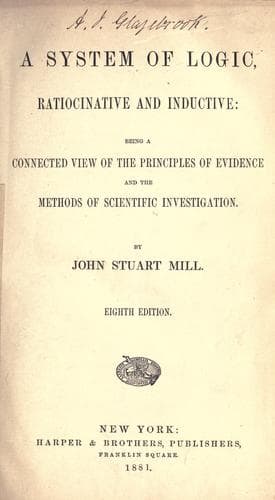
A System of Logic, Ratiocinative and InductiveMill, John Stuart
PhilosophyPhilosophy
A System of Logic, Ratiocinative and Inductive
Mill, John Stuart
Knowledge, Theory of; Logic; Science -- Methodology
The assertion, therefore, which, according to Hobbes, is the only one made
in any proposition, really is made in every proposition: and his analysis
has consequently one of the requisites for being the true one. We may go a
step further; it is the only analysis that is rigorously true of all
propositions without exception. What he gives as the meaning of
propositions, is part of the meaning of all propositions, and the whole
meaning of some. This, however, only shows what an extremely minute
fragment of meaning it is quite possible to include within the logical
formula of a proposition. It does not show that no proposition means more.
To warrant us in putting together two words with a copula between them, it
is really enough that the thing or things denoted by one of the names
should be capable, without violation of usage, of being called by the
other name also. If, then, this be all the meaning necessarily implied in
the form of discourse called a Proposition, why do I object to it as the
scientific definition of what a proposition means? Because, though the
mere collocation which makes the proposition a proposition, conveys no
more than this scanty amount of meaning, that same collocation combined
with other circumstances, that _form_ combined with other _matter_, does
convey more, and the proposition in those other circumstances does assert
more, than merely that relation between the two names.
The only propositions of which Hobbes’s principle is a sufficient account,
are that limited and unimportant class in which both the predicate and the
subject are proper names. For, as has already been remarked, proper names
have strictly no meaning; they are mere marks for individual objects: and
when a proper name is predicated of another proper name, all the
signification conveyed is, that both the names are marks for the same
object. But this is precisely what Hobbes produces as a theory of
predication in general. His doctrine is a full explanation of such
predications as these: Hyde was Clarendon, or, Tully is Cicero. It
exhausts the meaning of those propositions. But it is a sadly inadequate
theory of any others. That it should ever have been thought of as such,
can be accounted for only by the fact, that Hobbes, in common with the
other Nominalists, bestowed little or no attention upon the _connotation_
of words; and sought for their meaning exclusively in what they _denote_:
as if all names had been (what none but proper names really are) marks put
upon individuals; and as if there were no difference between a proper and
a general name, except that the first denotes only one individual, and the
last a greater number.
Public-domain text, read in full here on John Shaqi.
Reviews
Reviews
No reviews yet
Be the first to share your thoughts on this work.
Elsewhere in the archive
Join the Discussion
Join the discussion
Sign in to leave a comment or review.
Sign InorCreate an account