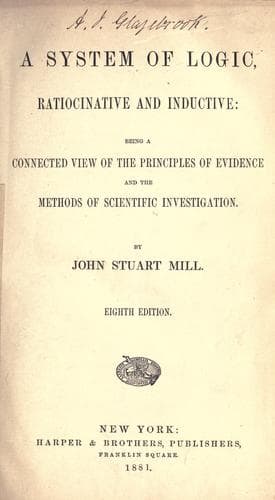
A System of Logic, Ratiocinative and InductiveMill, John Stuart
PhilosophyPhilosophy
A System of Logic, Ratiocinative and Inductive
Mill, John Stuart
Knowledge, Theory of; Logic; Science -- Methodology
It has been seen, however, that the meaning of all names, except proper
names and that portion of the class of abstract names which are not
connotative, resides in the connotation. When, therefore, we are analyzing
the meaning of any proposition in which the predicate and the subject, or
either of them, are connotative names, it is to the connotation of those
terms that we must exclusively look, and not to what they _denote_, or in
the language of Hobbes (language so far correct) are names of.
In asserting that the truth of a proposition depends on the conformity of
import between its terms, as, for instance, that the proposition, Socrates
is wise, is a true proposition, because Socrates and wise are names
applicable to, or, as he expresses it, names of, the same person; it is
very remarkable that so powerful a thinker should not have asked himself
the question, But how came they to be names of the same person? Surely not
because such was the intention of those who invented the words. When
mankind fixed the meaning of the word wise, they were not thinking of
Socrates, nor, when his parents gave him the name of Socrates, were they
thinking of wisdom. The names _happen_ to fit the same person because of a
certain _fact_, which fact was not known, nor in being, when the names
were invented. If we want to know what the fact is, we shall find the clue
to it in the _connotation_ of the names.
A bird or a stone, a man, or a wise man, means simply, an object having
such and such attributes. The real meaning of the word man, is those
attributes, and not Smith, Brown, and the remainder of the individuals.
The word _mortal_, in like manner connotes a certain attribute or
attributes; and when we say, All men are mortal, the meaning of the
proposition is, that all beings which possess the one set of attributes,
possess also the other. If, in our experience, the attributes connoted by
_man_ are always accompanied by the attribute connoted by _mortal_, it
will follow as a consequence, that the class _man_ will be wholly included
in the class _mortal_, and that _mortal_ will be a name of all things of
which _man_ is a name: but why? Those objects are brought under the name,
by possessing the attributes connoted by it: but their possession of the
attributes is the real condition on which the truth of the proposition
depends; not their being called by the name. Connotative names do not
precede, but follow, the attributes which they connote. If one attribute
happens to be always found in conjunction with another attribute, the
concrete names which answer to those attributes will of course be
predicable of the same subjects, and may be said, in Hobbes’s language (in
the propriety of which on this occasion I fully concur), to be two names
for the same things. But the possibility of a concurrent application of
the two names, is a mere consequence of the conjunction between the two
attributes, and was, in most cases, never thought of when the names were
Public-domain text, read in full here on John Shaqi.
Reviews
Reviews
No reviews yet
Be the first to share your thoughts on this work.
Elsewhere in the archive
Join the Discussion
Join the discussion
Sign in to leave a comment or review.
Sign InorCreate an account