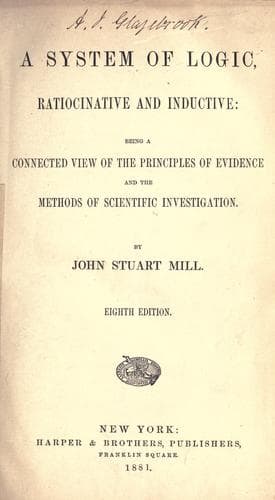
A System of Logic, Ratiocinative and InductiveMill, John Stuart
PhilosophyPhilosophy
A System of Logic, Ratiocinative and Inductive
Mill, John Stuart
Knowledge, Theory of; Logic; Science -- Methodology
§ 4. Let the predicate be, as we have said, a connotative term; and to
take the simplest case first, let the subject be a proper name: “The
summit of Chimborazo is white.” The word white connotes an attribute which
is possessed by the individual object designated by the words “summit of
Chimborazo;” which attribute consists in the physical fact, of its
exciting in human beings the sensation which we call a sensation of white.
It will be admitted that, by asserting the proposition, we wish to
communicate information of that physical fact, and are not thinking of the
names, except as the necessary means of making that communication. The
meaning of the proposition, therefore, is, that the individual thing
denoted by the subject, has the attributes connoted by the predicate.
If we now suppose the subject also to be a connotative name, the meaning
expressed by the proposition has advanced a step further in complication.
Let us first suppose the proposition to be universal, as well as
affirmative: “All men are mortal.” In this case, as in the last, what the
proposition asserts (or expresses a belief of) is, of course, that the
objects denoted by the subject (man) possess the attributes connoted by
the predicate (mortal). But the characteristic of this case is, that the
objects are no longer _individually_ designated. They are pointed out only
by some of their attributes: they are the objects called men, that is,
possessing the attributes connoted by the name man; and the only thing
known of them may be those attributes: indeed, as the proposition is
general, and the objects denoted by the subject are therefore indefinite
in number, most of them are not known individually at all. The assertion,
therefore, is not, as before, that the attributes which the predicate
connotes are possessed by any given individual, or by any number of
individuals previously known as John, Thomas, etc., but that those
attributes are possessed by each and every individual possessing certain
other attributes; that whatever has the attributes connoted by the
subject, has also those connoted by the predicate; that the latter set of
attributes _constantly accompany_ the former set. Whatever has the
attributes of man has the attribute of mortality; mortality constantly
accompanies the attributes of man.(35)
Public-domain text, read in full here on John Shaqi.
Reviews
Reviews
No reviews yet
Be the first to share your thoughts on this work.
Elsewhere in the archive
Join the Discussion
Join the discussion
Sign in to leave a comment or review.
Sign InorCreate an account