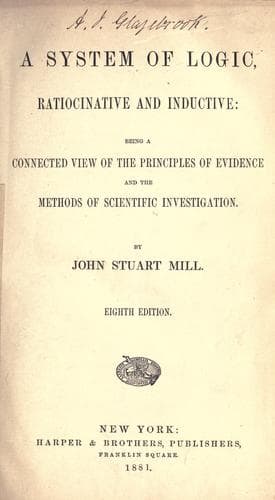
A System of Logic, Ratiocinative and InductiveMill, John Stuart
PhilosophyPhilosophy
A System of Logic, Ratiocinative and Inductive
Mill, John Stuart
Knowledge, Theory of; Logic; Science -- Methodology
If it be remembered that every attribute is _grounded_ on some fact or
phenomenon, either of outward sense or of inward consciousness, and that
to _possess_ an attribute is another phrase for being the cause of, or
forming part of, the fact or phenomenon upon which the attribute is
grounded; we may add one more step to complete the analysis. The
proposition which asserts that one attribute always accompanies another
attribute, really asserts thereby no other thing than this, that one
phenomenon always accompanies another phenomenon; insomuch that where we
find the latter, we have assurance of the existence of the former. Thus,
in the proposition, All men are mortal, the word man connotes the
attributes which we ascribe to a certain kind of living creatures, on the
ground of certain phenomena which they exhibit, and which are partly
physical phenomena, namely the impressions made on our senses by their
bodily form and structure, and partly mental phenomena, namely the
sentient and intellectual life which they have of their own. All this is
understood when we utter the word man, by any one to whom the meaning of
the word is known. Now, when we say, Man is mortal, we mean that wherever
these various physical and mental phenomena are all found, there we have
assurance that the other physical and mental phenomenon, called death,
will not fail to take place. The proposition does not affirm _when_; for
the connotation of the word _mortal_ goes no further than to the
occurrence of the phenomenon at some time or other, leaving the particular
time undecided.
Public-domain text, read in full here on John Shaqi.
Reviews
Reviews
No reviews yet
Be the first to share your thoughts on this work.
Elsewhere in the archive
Join the Discussion
Join the discussion
Sign in to leave a comment or review.
Sign InorCreate an account